Chinese tourists returning to Seoul
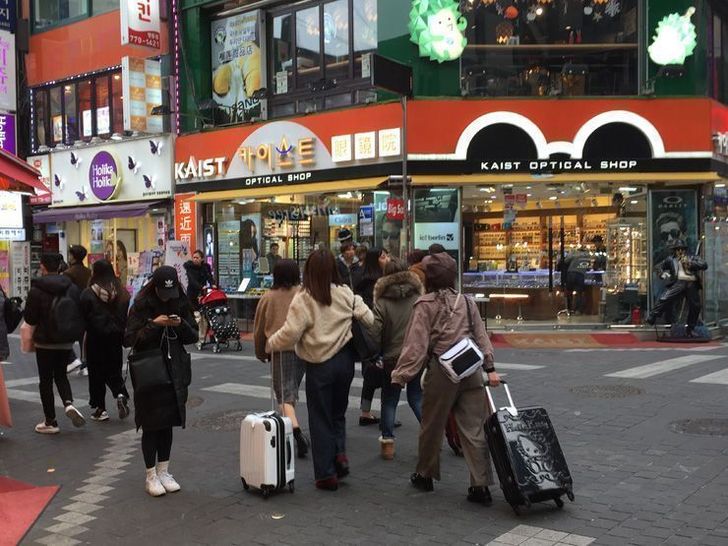
Foreign visitors shop in Myeong-dong, Seoul, Monday. Following the improving of Sino-Korean relations, more Chinese tourists are expected to visit Korea in the coming months. / Korea Times photo by Kang Seung-woo
Shops, restaurant prepare for Chinese visitors in droves
By Kang Seung-woo
As Seoul had the first snow of the season this week, the streets of Namdaemun Market and Myeong-dong were crowed with Chinese tourists.
A cosmetic shop promotes its buy-two-get-one-more sales offer in Chinese in Myeong-dong, Seoul, Monday. / Korea Times photo by Kang Seung-woo
Despite a sudden cold snap, with below-freezing temperatures, they were busy purchasing items at Seoul’s favorite tourist attractions among Chinese.
The scenes are the best indication of an easing of Sino-Korean diplomatic tensions over Seoul’s decision to deploy an advanced U.S. missile shield on the Korean Peninsula.
Angered by the deployment, the Chinese government banned travel agencies from selling travel packages to Korea in March _ a move hitting the nation’s tourism industry that was heavily dependent on Chinese tourists.
Last year, 8.06 million Chinese visited Korea, accounting for 46.8 percent of the 17.2 million foreign tourists who came here.
“Definitely, the number of Chinese tourists visiting here increased, compared with last month,” said a salesclerk of a cosmetics store in Myeong-dong.
“As the bilateral relations are beginning to thaw, we expect sales for next month will get better.”
On Oct. 31, the two governments agreed to mend their ties that had been soured by the deployment of the Terminal High Altitude Area Defense (THAAD) system.
Earlier this month, President Moon Jae-in and his Chinese counterpart Xi Jinping held a summit in Vietnam, where the two heads of state also concurred on putting Seoul-Beijing ties back on track.
“Due to China’s THAAD retaliation, the number of Chinese tourists visiting Namdaemun Market took a sharp dive, compared with the previous years,” said a restaurant owner who wanted to be identified by the surname Kim.
“As the bilateral relations between Korea and China are getting back on track, I hope more Chinese tourists will visit here.”
Although the Chinese government has yet to officially lift the travel ban, the return of Chinese tourists is visible in other places, as well.
Many Chinese tourists are visiting Digital Media City (DMC), where local broadcasters are stationed.
A traditional Korean restaurant in DMC, even on Sunday evening, was filled with Chinese.
“Recently, I witnessed a number of Chinese people visiting DMC and they often come to our store,” a restaurant employee said. “More Chinese are coming here, so we expect many of them will visit our restaurant.”
The advent of Chinese tourists is evidenced by sales at local department stores.
According to Lotte Department Store, its November sales to Chinese customers increased by 20 percent per day from the previous month.
Shinsegae Department Store also saw its sales to Chinese gain 13 percent in October and November sales increased by 23.6 percent.
The Korean government believes the influx of Chinese tourists will surge after next month’s Korea-China summit.
President Moon is set to make his first presidential trip to China next month, where he will sit down with Xi.
“Following the summit, the Chinese government is expected to end its ban on hallyu, or the Korean wave, and travel packages to Korea,” Culture, Sports and Tourism Minister Do Jong-hwan said.
According to the Korea Tourism Organization, the country’s tourism-related income came to $8.85 billion in the January-August period, down 23.6 percent from a year before, due largely to a drop in Chinese visitors.
In particular, the number of Chinese tourists to Korea more than halved between March and August, decreasing to 1.71 million from 4.53 million in the same period last year.