Prosecution set to start probe
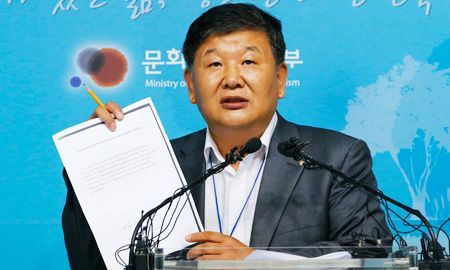
Noh Tae-gang, director at the Ministry of Culture, Sports and Tourism, shows reporters a copy of a document during a news conference at the ministry, Monday, while explaining how Gwangju had forged a government guarantees for the 2019 World Swimming Championships. / Yonhap
By Kim Jae-won
The government filed Monday a complaint with the prosecution against Gwangju Metropolitan City, accusing the southwestern city of forging official documents to host an international swimming competition.
The Ministry of Culture, Sports and Tourism said that it took the legal action against the municipal government because Gwangju submitted fake documents to the international swimming body FINA. Gwangju claimed that the government will support the city financially in its applications to host the World Swimming Championships in 2019, which the government denied.
FINA announced Friday that Gwangju has become the host city of the FINA World Championships in 2019, fulfilling all the organization’s bidding requirements, including financial responsibility.
“We filed a complaint with the Gwangju District Prosecutors’ Office this morning against Gwangju city over its forging of official documents. We also have no plan to support the city financially in hosting the swimming competition,” said Lee Jeong-woo, a director of the ministry.
Gwangju Mayor Kang Un-tae apologized to the government for “adding statements and signatures” on its initial documents, but questioned why the central government announced it right before the announcement of the bidder, though it acknowledged it in April.
“I am sorry for adding statements and signatures to the government’s documents submitted to FINA. However, it is regrettable that the government raised the issue on the very day of the announcement of the bidding city,” said Kang in a press conference.
Commentators say that they could not understand how the municipal government could forge official documents and signatures of the sports minister and the prime minister.
“It is something that should not have happened. How dare the city think of this which is even rare between individuals?” said Hong Hyung-shik, a director at Hangil Research, a Seoul-based opinion research center.
Hong said that Gwangju should acknowledge its wrongdoings first, and then the two parties may discuss solutions, if there are any.
Others say that it is apparent that Gwangju used unfair methods by forging official documents, but they also criticized the government for dealing with the matter immaturely.
“Considering Gwangju has politically sensitive feelings against the central government, its emotional reactions to the city may provoke some needless misunderstandings,” said Lee Kang-yun, a freelance news commentator.
Gwangju is the political hometown of the main opposition Democratic Party, while the ruling Saenuri Party is strongly supported by Daegu, Busan and Gyeongsang provinces located in southeastern part of the country.
Lee said that the government’s support for Gwangju was too little, compared to its helping Daegu which hosted the International Association of Athletics Federations World Championships in 2011. The government gave 1.5 trillion won to Daegu, supporting the city financially to host the sports event, according to the government’s official blog on the competition.