Tears and relief as Korean worker detained in US recounts days in custody
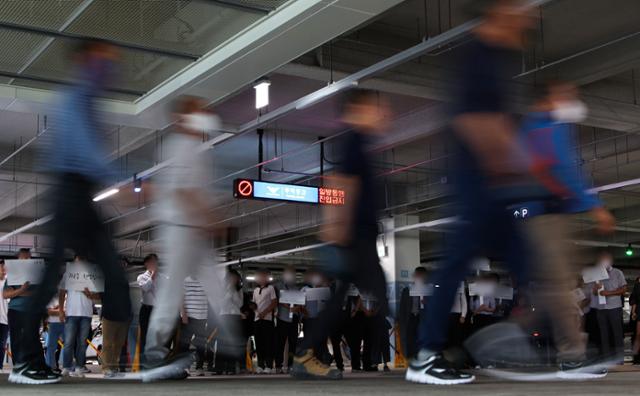
South Korean workers freed from U.S. immigration detention arrive at the long-term parking lot of Incheon International Airport, Friday. Hankook Ilbo
A Korean worker who was among those detained by U.S. immigration authorities at the Hyundai Motor-LG Energy Solution joint battery plant in Georgia said his only thought during the ordeal was to leave the detention facility as soon as possible.
Lee, 58, an employee of an LG Energy Solution subcontractor, returned to Korea on Friday after eight days in detention. He had traveled to Georgia in February on a short-term B-1 business visa to oversee equipment installation at the construction site. “I just wanted to end this situation quickly and get out of that building (the detention facility),” he said, recalling the moment his return was suddenly delayed earlier this week.
Wearing a black T-shirt, jeans and a mask, Lee boarded a bus at the long-term parking lot immediately after arriving at Incheon International Airport to meet his family. His wife, Park, 56, anxiously waited on the fourth floor, muttering, “When is he coming? I can’t see him.” At 4:17 p.m., Lee appeared with open arms, and Park broke into tears. “You must have suffered so much,” Lee said as he patted her shoulder. He also greeted his colleagues before heading home with his wife.
According to Lee, the arrest came without warning. On Sept. 4 (local time), U.S. Immigration and Customs Enforcement (ICE) officers carrying guns entered the construction site, ordering workers to stop and follow them. “I explained I had a B-1 visa, but they said, ‘Because you were inside the facility, you need to be investigated regardless,’” he recalled. Workers were taken onto buses and handcuffed before being transported to a facility in Folkston, Georgia, within two hours.
At the facility, their belongings and phones were confiscated, and they were issued prison uniforms and identification numbers known as “alien numbers.” Lee was placed in a two-person cell. While conditions were basic, he said detainees could walk in the yard and talk with one another outside of designated head counts and curfew hours. “We shared news from lawyers and staff with each other,” he said.
Despite the shock, Lee said he was not afraid because he had entered the U.S. legally. “I believed it would be resolved eventually. I heard the government quickly organized a response team the next day, and the officers weren’t particularly coercive,” he said. “They maybe realized they had made a mistake. They canceled the B-1 visa but told me I could apply for another one without restrictions.”
Still, Lee described mental anguish when his release was postponed on Wednesday, despite an initial plan for return that day. “At that point, I just wanted to end it and get out of the building. Everyone there felt the same way,” he said.
Lee added that while the facility was uncomfortable, conditions were not as severe as reported. “The beds and rooms were poor, and the bathrooms were cramped, but I didn’t see insects,” he said. Meals were served in a typical American style.
Asked if he would return to the U.S., Lee replied cautiously, “It seems safest to go on an E-1 or L-1 visa with no issues.” For now, he added, “I just want to be with my family.”
This article from the Hankook Ilbo, the sister publication of The Korea Times, is translated by a generative AI system and edited by The Korea Times.