'Hansik' joins Milan expo menu
.jpg?w=728)
An artist’s conception of the Korean Pavilion at the Expo Milano 2015, which kicks off on May 1. A moon jar, a traditional Korean porcelain container used for storing food, inspired the design of the Korea Pavilion building. / Courtesy of Korea Tourism Organization (KTO)
By Lee Min-hyung
Traditional Korean foods or “hansik” will be promoted at the upcoming Expo Milano 2015 under the theme “Hansik, Food for the Future: You Are What You Eat.”
To raise awareness not only for Korean cuisine, but also for a balanced diet, the restaurant Korea Pavilion will offer six menus based on three themes — “Harmony,” “Healing” and “Health” — during the six-month food event, which kicks off on May 1.
“Our goal is to let the world know Hansik could be a good alternative foods for the future,” said Park Min-gwon, first vice minister of Culture, Sports and Tourism. “We hope to discuss issues regarding sustainable foods during the expo.”
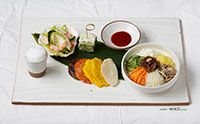
“Bibimbap,” a popular Korean rice-based dish with assorted vegetables, represents the “harmony” menu. / Courtesy of Bibigo
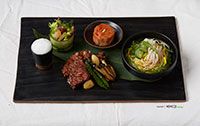
Noodles with vegetables and white kimchi represent the “health” menu at the Korea Pavilion restaurant. / Courtesy of Bibigo
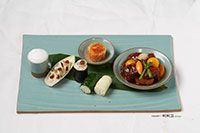
The “healing” menu includes “ssambap” or leaf-wrapped rice and “galbi-jjim” or braised short ribs. / Courty of Bibigo
“Bibimbap,” a popular Korean rice-based dish, will represent the “Harmony” menu because it is usually served with a colorful array of vegetables. During the expo, it will also be served with seaweed.
The “Healing” menus include “ssambap” or vegetable-wrapped rice and “galbi-jjim” or braised short ribs.
The Health menus are represented by fermented foods, including kimchi.
Bibigo, a chain of restaurants owned by CJ Foodville, is in charge of running the Korean restaurants during the expo.
“We frequently held food tasting events targeting Italian chefs and restaurant staff,” said Kim Byung-pil, Bibigo's director of research and development (R&D) center.
“The Korea Pavilion restaurant will serve not just our traditional foods, but also grocery items used for making Korean foods,” Kim said. “The foods and grocery items will help visitors see, taste and feel our traditional cuisine.”
The design of the Korea Pavilion building was inspired by a “moon jar,” a traditional Korean porcelain used for storing foods. It is the ninth largest building among those of the expo’s 145 participating countries.
The Korean restaurant will be located on the first floor of the three-story building during the expo. The second floor will be used mainly for exhibitions about Korean foods. The exhibitions are organized around three themes: “What Our Bodies Tell Us,” “Hansik, Ask and Korean Wisdom Shall Answer” and “Hansik, Food for the Future.”
The opening ceremony of the Korea Pavilion building will be held at 4 p.m. on May 1.