Foreign brides keep coming in search of better life

Five Korean men and their brides from Vietnam and the Philippines pose after holding a traditional Korean wedding ceremony at the Seocho Cultural Arts Center in Yangjae-dong, southern Seoul, on May 22. / Yonhap
Money is often hidden cause for breakup of interracial couples
By Kim Ji-soo
Beginning in the early 1990s, middle-aged Korean bachelors in the countryside found it difficult to find Korean brides as young women left for the city in search of a better life.
As a result, arranged interracial marriages became popular as local governments, fearing depopulated rural areas, helped finance marriage brokers seek foreign brides for farmers and others and offered additional support for couples if they met certain requirements.
Korea, like many Asian countries, has long had a tradition of arranged marriages and marriage brokers have been accepted as part of the process. Interracial marriages were also not that unusual since Korean men and women working abroad have often found foreign mates.
Kim Mose, 60, chairman of Sky Multiculturalism Corp., witnessed it firsthand.
“I turned my eyes overseas after Korea established diplomatic relations with China and Vietnam in 1992,” said Kim, a veteran marriage broker.
As Korea was a relatively homogeneous society, the initial pool of foreign wives was sought among Korean-Chinese brides in the three northeastern Chinese provinces of Lioaning, Jilin and Heilongjiang.
“Brides at the time were hardworking and really tried hard to settle down in rural households,” Kim said.
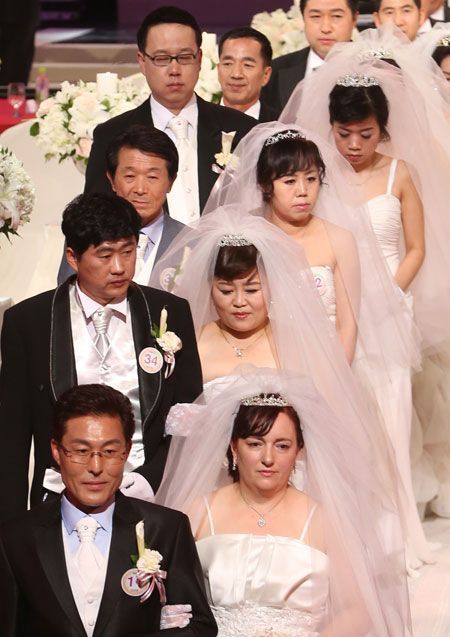
Interracial couples and North Korean defectors tie the knot in a joint ceremony for a total of 50 couples at the KBS Hall in Yeouido, Seoul, in this April 21 file photo. / Yonhap
But when the 1997 financial crisis hit Korea, Korean bachelors lost their appeal among Korean-Chinese women, who at the same time were finding it easier to obtain work visas in Korea on their own.
Marriage brokers then turned to Vietnamese women, with the number of such marriages increasing rapidly between 2002 and 2006. Kim said during this period that he was arranging as many as 30 marriages a month.
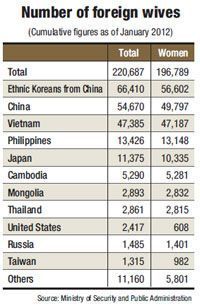
As of January 2012, there were a total of 220,687 migrant wives and husbands in Korea. The largest group consists of ethnic Koreans from China at 56,602, followed by ethnic Chinese women and those from Vietnam, the Philippines, Japan, Cambodia, Mongolia and Thailand.
Marriage brokers normally make a profit of between 1 million and 5 million won for each marriage. The husband bears most of the cost, normally spending 12 million won or more for introduction meetings, the marriage ceremony and honeymoon, and gifts and money to the bride’s family.
Brokers draw up contracts detailing the procedures for the arranged marriage and how much it will cost. The marriages usually take place in the bride’s native country.
After the brokers collect their money once the couples are married, few of them are interested in helping the foreign wives if they face problems in Korea.
Brokers usually only remain involved in cases where a marriage is dissolved within the first 90 days because the bride failed to come to Korea or ran away. In these cases, the brokers must compensate by setting up another meeting with a prospective foreign bride or pay back some of the money to the husband.
The wives enter with an F-6 marriage visa, and within 90 days of marriage, can receive a foreign registration card that legally grants them a stay of three years in theory. In practice, the Ministry of Justice grants a one-year valid foreign registration card and then renews it for two more years after ensuring that the marriage is real and valid.
If brokers are found to have provided incorrect information about either marriage partner, operated without a certified license or recruited a foreign bride younger than 18, local government officials can decide on a punishment ranging from a fine and jail term to closing the business. Officials are also cracking down on online broker agencies that often operate without a license.
But there are only a small number of local government officials who supervise marriage brokers. Investigations largely depend on complaints against brokers filed with the authorities.
During the second half of 2012, only 43 violations that were punishable by administrative orders were filed against the 1,531 registered marriage brokers, according to the Ministry of Gender Equality and Family.
The government is trying to strengthen the law to make life difficult for unsavory brokers and imposing new rules screening Korean grooms.
In response to the rise in multiracial marriages, the government began regulating marriage brokers in June 2008. Brokers are now required to provide basic information on the health and employment of the applicants, including any mental health problems _ after a Korean man with a history of insanity killed his young Vietnamese bride in August 2010, just a week after she arrived in Korea.
In addition, the government has mandated that from August marriage brokers must have 100 million won in assets to be legally registered in a move to weed out shady one-man marriage merchants.
Kim Suck-ju, who matches brides from Vietnam with Koreans, is seriously considering whether to continue with her business. “Putting up 100 million won in capital is not easy,” she said.
Kim Mose is waiting to see what happens to the brokers market.
“We’re all watching to see what happens. But my feeling is that the small ones will be weeded out,” he said.
The gender equality ministry suggests that those using marriage brokers should make sure that they are legally registered and have warranty insurance. The brokers should also be able to certify that foreign brides should have the right qualifications to receive an F-6 marriage visa.
Mo Kuoung-soon, chief director of the Emergency Support Center for Migrant Women, said the main problem with marriage brokers was their prime motive in making money.
“I think we should ban international marriage brokers if we can,” said Mo. “But if that is impossible, we need to regulate them strictly,” such as limiting the number of interracial marriages a broker can arrange in a set period of time.
Kim Suck-ju disagreed. “Banning brokers will only lead to the emergence of shadier brokers.”
Marriage brokers acknowledge that money is an important factor behind interracial marriages.
Kim Mose says that an Uzbek female high school graduate, for example, makes only one-10th of the amount of money that a Korean man from a similar background makes, so she sees the marriage as a form of financial security.
“When someone is under financial pressure, he or she takes bold risks. It’s not something just anybody can do,” Kim said.
Most of the Korean men are in their 40s and see marriage with a foreign bride as a last chance to have a family.
“Brokers should be sensitive to the needs of their clients and make sure that both parties have the desire to enter and stay in a marriage before introducing a couple,” he said.
“I think that for brokered international marriages, the man should visit the foreign country at least twice before the marriage so he understands local customs as well as gets to know his prospective partner better,” Kim said. “I think the government should make that a legal requirement.”
Kim says that money alone should not be the reason for interracial marriages. “Money is obviously one factor. But I think people who go into interracial marriages should be aware that they are making a choice. I think there are many merits to such a marriage, and I would encourage it. In fact, my sister-in-law is Vietnamese.”