Ahn Yong-bok told of Dokdo, Ulleungdo

A statue of Ahn Yong-bok in Suyeong Historical Park in Busan. The Joseon-era (1392-1910) fisherman was captured and taken to Japan, where he testified that Ulleung Island and Dokdo were Korean territory, part of Gangwon Province.
By Kim Ji-soo
A fisherman who lived during the Joseon Kingdom (1392-1910) is still celebrated in Seoul and Busan for helping to strengthen Korea’s sovereignty claim on Dokdo, the nation’s easternmost islets.
In the Dokdo Museum Seodaemun in Seoul, Ahn Yong-bok’s story is concisely presented for all to read. In the southeastern port of Busan, a statue of him stands in Suseong Historical Park alongside “Sugangsa,” a shrine built in his honor.
A commemorative festival is held on Ulleung Island every year and a non-profit organization carries out various events to highlight Ahn’s contribution. Singer Kim Jang-hoon announced a “21st-century Ahn Yong-bok Project,” a multi-faceted campaign to promote Korea’s sovereignty over the rocky islets in the East Sea.
But personal information on Ahn remains elusive; there are no definitive records of his date of birth or when he died.
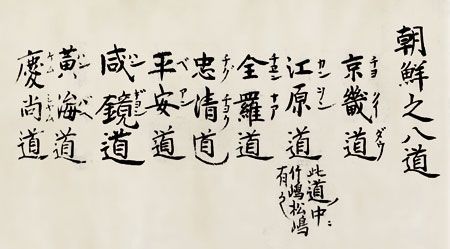
A portion of a copy of the “Map of the Eight Provinces of Joseon” that Ahn made and provided to the Japanese on his second visit to Japan in 1696. Courtesy of Dokdo Museum, Seoul
A Joseon “silhak” scholar Yi Ik wrote in “Seongho Saseol” (1761) that Ahn was a hero who accomplished what others could not.
In the “Annals of Joseon Kingdom,” there is a section which quotes Ahn as saying “I live in Dongnae but was on my way to Ulsan to visit my mother, and then talked with Monk Noeheon about my travels to Ulleungdo.”
It was his encounters with Japanese fishermen and authorities and his passages to Japan in 1690s that brought the issue of Dokdo, located in the East Sea, to the fore.
“Ahn’s incident prompted Korea and Japan to start a territorial debate over Dokdo, and led the Edo Shogunate to conclude that Ulleung Island and Dokdo was not part of Tottori Domain, and barred Japanese from crossing to Ulleung Island in a declaration in January 1696, Prohibition of Sailing to Takeshima,’” said Chung Young-mi, director of the Dokdo Museum Seoul and a researcher at the Northeast Asian History Foundation.
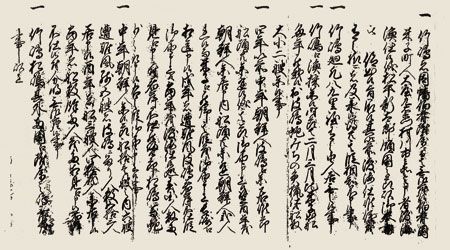
A record of the answer given by the “daimyo” lord of Tottori Domain to a question from the Edo Shogunate in 1695. In response to the question as to whether “any islands are attached to Tottori Domain other than Ulleungdo,” the daimyo answered by making a reference to the size of Ulleungdo and stated that “Ulleungdo and Dokdo do not belong to Tottori Domain.”
The East Sea islands were recorded as belonging to “Usanguk” during the Three Kingdoms Period, and then as “Usando” during the Joseon Kingdom. Then mentions of Usando continued to appear in Korean historical records from the 15th to the 20th centuries including on “Jiriji” (Book of Geography) of “Sejong Sillok” (1454).
But in the mid-17th century, the central government at that time asked its inhabitants to resettle to the mainland for safety reasons. During those years, Japanese fisherman, as well as Korean, began visiting the islands.
In 1693 Ahn and Bak Eodun were captured by the Japanese and taken to Oki Islands. Ahn, who spoke Japanese well, questioned the Oki Island administrator, “Ulleungdo and Dokdo belong to Joseon. It is close to Joseon and far from Japan. Why then is it that you have captured me?”
After his first journey, he was detained and questioned for months in Japan and then years in Korea. Unaware of the developments following his deposition in 1693, he headed to Japan again in May 1696 to declare once again that the two islands belonged to Korea.
But this followed his first visit that eventually prompted the Edo Shogunate to ask the Tottori Domain about Takeshima that led to an answer from the Tottori Domain that “no other island belongs to the domain including Takeshima (Ulleungdo) and Matsushima (Dokdo).” Korea also began to actively send investigating officials once again to the islets.
The Korean historical document “Veritable Records of King Sukjong” (“Sukjong Sillok”) details that on his second visit Ahn said to the Japanese that “Matsushima (that is Dokdo) is Usando (that is Dokdo), and that is Korean territory” and went to Japan to protest against Japanese claims there.
In Japan’s “Memorandum Concerning the Korean Boat that Came alongside the Pier in 1696),” it states that “Ahn Yong-bok argued that Takeshima (that is Ulleungdo) and Matsushima (that is Dokdo) are under the jurisdiction of Gangwon Province.
For its part, Japan has long insisted that Ahn gave false testimony to the authorities. But the discovery in 2005 of the “Memorandum” provided evidence supporting the fisherman’s original deposition.
When Japan’s most powerful authority in 1877 — the State Council — acknowledged the islets as Korean territory, his deposition helped to lay the groundwork.