Uzbekistan's Islam Karimov - people's president

The beautiful Gur Emir is a mausoleum of the conqueror Timur, also known as Tamerlane, in Samarkand. It is one of the main tourist attractions in Uzbekistan. / Korea Times file
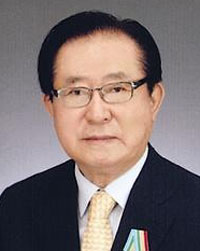
Kim Young-gu
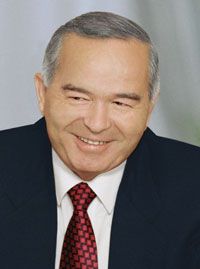
Uzbek President Islam Karimov
By Kim Young-gu
It is a great privilege for me to address today the esteemed readers of The Korea Times on the occasion of a festive event for the people of Uzbekistan – the 75th birthday of its leader, President Islam Karimov.
Karimov has played an important role in Uzbekistan’s independence, strengthening the country’s sovereignty, improving the livelihood of its people and raising the international standing of the young republic on the world arena.
I have been to Uzbekistan on a number of occasions: as chairman of the Korean Federation of Small and Medium Business, as a member of the National Assembly of Korea and as head of a private company. I had the honor to meet in person with Karimov who impressed me with his deep knowledge of geopolitics and the international economy as well as with his far-sightedness and modesty.
It is impossible to illustrate the many-sided personality of the man in a short article, since it’s difficult to appreciate the contribution of the leader of Uzbekistan in acquiring and strengthening the independence of the country, in transforming it to a democratic nation with dynamic economic growth, and in its becoming a full member of the international community.
On Aug. 31, 1991, the independence of the Republic of Uzbekistan was declared. At that time, one could not even imagine what kind of complex and difficult challenges were facing the young state, which had recently appeared on the world map.
The most serious threat was posed by the legal vacuum in the breakdown of internal and external security, the risk of inter-ethnic, inter-religious, inter-regional and clan conflicts, and the growth of radicalism. In a nutshell, it was necessary to protect the nation from internal and external conflicts.
During that difficult time, it was essential to acquire self-preservation, endurance and strong political will, and to develop a comprehensively considered and calibrated strategy for pulling the country out of the deep crisis and mobilizing the constructive power of the society for that purpose.
The strategy of political and economic development as well as of the construction of the nation and society, which has been developed with the direct involvement of Karimov, had its foundation on the historical and cultural features of Uzbekistan’s people and a strict assessment of the natural, economic and human potential of the nation.
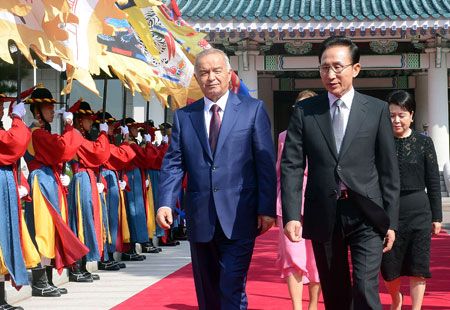
President Lee Myung-bak, right, and Uzbek President Islam Karimov inspect a guard of honor at Cheong Wa Dae on Sept. 20 last year. / Korea Times file
In a historically short period of time, the country has developed and adopted basic law, the Constitution of the Republic of Uzbekistan, which clearly sets out the basic principles of state and nation building.
Karimov has developed a unique model for Uzbekistan's transition to a socially-oriented free market economy, based on five principles: de-idealization; pragmatic economic policy, manifested in the primacy of the economy over politics; the appointment of the state as the main reformer; rule of law; the enforcement of a strong social policy and consistency in the implementation of reforms.
Thanks to the fundamental changes and reforms in the political system, Uzbekistan has been able to ensure rapid and sustainable development of its economy. Since independence, its economy has grown 3.7 times, real per capita income has increased seven-fold and life expectancy has increased by an average of seven years.
Uzbekistan has achieved important strategic objectives in energy and grain self-sufficiency. A coherent implementation of large-scale modernization programs and a technical and technological renovation of enterprises involving the most advanced technologies has accelerated the development of high-tech industries such as energy, oil, gas, non-ferrous metal, chemical, textile, machinery, automobile, pharmaceutical and microbiology industries, which are the engines of our economic growth.
The growth of GDP in 2012 marked 8.2 percent, while from 2000 to 2011 gross domestic product grew by than two-fold. This shows that Uzbekistan is among the fastest-growing economies in the world.
It is also important to mention the significant achievement in the education of the young generation, one of the government’s priorities. In 1997, under the leadership of Karimov, the national education program was established. This unique program was designed for a transition to a 12-year education system, which allows holistic continuous learning.
Uzbekistan’s positive results in reforming its economy, facilitating sustainable and balanced economic growth, and implementing anti-crisis measures have been recognized by a number of reputable and leading international financial and economic institutions such as the International Monetary Fund, World Bank and Asian Development Bank.
Karimov is a strong supporter of close relations with Korea. He has made a great contribution to developing multifaceted Uzbekistan-Korea cooperation that currently has reached a level of strategic partnership.
Оne should note that from the outset of Uzbekistan’s independence, Korea has been providing consistent support in the implementation of large-scale national programs of fundamental reform and a comprehensive modernization of the economy and social sphere of Uzbekistan.
Korea is one of the top-priority partners of Uzbekistan for trade, economy and investment. Over the past decade, bilateral trade has increased more than four-fold, and in 2011 it amounted to over $1.6 billion. During the first 11 months of 2012 it exceeded $1.64 billion. Each year, there is a growing number of Uzbek-Korean joint projects in the automobile, textile, construction, telecommunications, transport and mining sectors, which have truly become a symbol of Uzbek-Korean long-term cooperation. During the state visit of Karimov to the Korea last September the two countries signed investment contracts worth over $5 billion.
Karimov has also made a great contribution to supporting ethnic Koreans’ diaspora in Uzbekistan, the fourth-largest in the world with more than 200,000 people. The government of Uzbekistan has created all the necessary conditions for social, national-spiritual and cultural development as well as those of other nations and nationalities living in the country.
In conclusion, taking this opportunity, I would like to extend to President Islam Karimov my sincerest and heartfelt congratulations on his 75th birthday and wish him robust health and further successes in his important work of strengthening the independence and sovereignty of Uzbekistan, and to the people of Uzbekistan – I wish them wellbeing and prosperity.
The writer is president of Shindong Resources
and former chairman of Korean Federation of
Small and Medium Business.