Seoul urged to repair relations with Taiwan
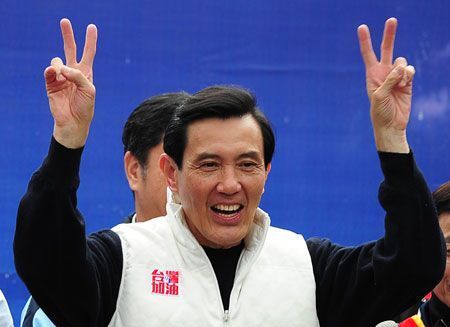
Taiwan President Ma Ying-jeou gestures to supporters during a campaign rally in Taipei in this 2012 file photo. / AFP-Yonhap
Kang Jun-young
By Sunny Lee
TAIPEI – During a recent conference here, sponsored by the Korea-China Association of Social Science Studies, Chen Te-sheng, who served as a senior security adviser to Taiwanese leader Ma Ying-jeou, opened his remarks with a zinger.
“Koreans don’t pay attention to Taiwan, except for one person,” Chen said at the elite National Chengchi University.
Last year Korea and China celebrated their 20th anniversary of knotting diplomatic ties. It was also the 20th year since Korea and Taiwan unknotted theirs.
“Taiwan has become an almost forgotten country to Koreans. It shouldn’t be,” Kang Jun-young, a China expert with Hankuk University of Foreign Studies, who also attended the conference, told The Korea Times afterwards.
Severing diplomatic ties with Taiwan was a key precondition Beijing demanded of all countries with which it inked diplomatic partnerships. For instance, Japan and the U.S. severed ties with Taiwan in 1972 and 1979, respectively.
“But compared to Japan or America, Korea didn’t make enough effort to compensate for the absence of official diplomatic relations through vigorous non-political exchanges such as people and cultural,” said Kang, adding Seoul should also recognize Taiwan as an important economic partner.
Taken together, he said: “If Korea forgets about Taiwan, it is only Korea’s loss. I hope our next president Park Geun-hye repairs ties with Taiwan.” Kang is a strong advocate for deepening Seoul-Taipei ties. And it’s no wonder that he was the person Chen was referring to at the conference.
Relations between Korea and Taiwan date back to 1949 when Taiwan set up an embassy in Seoul’s central Myongdong district. During the Cold War, the duo kept good company with each other in their shared ideological solidarity against their Communist neighbors, Beijing and Pyongyang. At that time, Koreans called Taiwan by an endearing term: “Freedom China,” to contrast it with mainland China.
The two were also very close culturally as they were the two most prominent preservers of Confucianism in the world. In fact, Korea was the last Asian country that kept an official diplomatic relationship with Taiwan.
Therefore, when Seoul in emulating the dominant global geopolitical trend, eventually in 1992 switched diplomatic recognition from Taiwan to China, people in Taiwan were shocked. Many Taiwanese living in Seoul gathered at their embassy where they saw the lowering of their national flag for once and for all.
As the scene was aired in Taiwan, many Taiwanese became very emotional, like experiencing a betrayal of friendship in a very Asian sense. Their shock quickly transformed into anger towards Korea.
Protesters took to the streets of Taipei. Angry mobs also surrounded the Korean mission building. At least one Taiwanese even tried to kill himself by burning, as a sign of protest.
Taiwan retaliated by banning Korean airlines, boycotting the imports of Korean fruits, and later turning a cold shoulders to Korean companies’ bids to enter Taiwanese industrial projects. Carrying a lot of emotional baggage, Taiwanese media have since also developed a tendency of dwelling on the negative aspects of Korea whenever possible, which was a very effective strategy to ignite anti-Korean sentiment in the island republic.
Ironically, Korea couldn’t care less, as it got completely infatuated with maddening economic flirtation with a wealthy new partner, Beijing.
Kang worries about the ongoing trend. “It’s time to heal our relationship and recognize each other afresh,” he said. Below is an excerpt from the interview.
Q
: You noted that there is still an alarming level of anti-Korean sentiment in Taiwan.
A
: Yes. Let me just take a few recent examples. The head of Taiwanese company Foxconn publicly said that Taiwan should unite with Japan’s Sony to combat Samsung. Taiwanese media, still licking the old wounds, jumped at the chance to splash the remark all over, igniting the brooding anti-Korean sentiment again. It’s what the Taiwanese media often do.
When Taiwanese female taekwondo athlete Yang Shu-Chun was disqualified at the 2010 Asian Games in China when she was leading 9-0 against her Vietnamese opponent, some Taiwanese people spread an ill-intended rumor that somehow Korea was behind the disqualification. It made the whole nation enraged. When something bad happens in Taiwan, Taiwanese media often attribute it to Korea. It works like magic because the image of Korea is very negative in Taiwan. I think it will take a long-term effort to mend the situation.
Q:
Like other countries in the world, Korea has been so preoccupied with the new global economic magnet, mainland China. That has somehow made Taiwan less visible on the global map, to be frank. Besides, Koreans tend to think of Taiwan primarily as a competitor in global markets, such as in the semiconductor field.
A:
That’s only half true. The two countries compete most fiercely in the semiconductor area, but in 2011, in the very same area, the bilateral trade volume became a whopping $12 billion. In the steel industry, Korea exported $500 million to, and imported $600 million from Taiwan. Yes, we compete, but we also cooperate. We have a very strong complementary intra-industrial sector. Let’s recognize both the tree and the woods.
You also urged that Korea should “rediscover” Taiwan as a major economic power.
My argument is backed by figures. As of 2011, Taiwan was Korea’s 6th largest trading partner. What that means is that Seoul’s exports to Taiwan are greater than that of what Korea exports to all of Africa combined. Over 500,000 Taiwanese tourists visit Korea, which is the 4th in the world, trailing only behind Japanese, Chinese and Americans. You may not know this but Taiwan is also a huge market for Korea’s cultural products. Taiwanese click more “Korean Wave” contents online than any other country in the world.
What then should Korea do?
The Korean government cares too much about Beijing’s face and refrains from sending high-level personnel to Taiwan for various non-political events. When leaders in Korean society don’t pay enough attention to Taiwan, the general public follows the cue. Over the years, it has created an overall social amnesia on the part of Koreans on Taiwan. Of course, it comes with price. For example, it’s difficult for Korean companies to win a major industrial project in Taiwan because we lack personal ties with the senior Taiwanese leadership, which as you know is very important in making a successful deal in Asian culture.
But as you alluded, Beijing may frown upon Seoul’s inching closer towards Taiwan.
My view is different. I think Korea should be able to use “the Taiwan card” as useful leverage against China, in both the political and economic realms. In fact, I think Korea and Taiwan are the two countries in the world that most resemble each other, like twins. The two both rely on the U.S. for their security, yet at the same time both also rely on China for economic growth. Both are countries whose economies are ranked within the top 20 globally. The two’s per capita income levels are also similar, surpassing the $20,000-mark in recent years. We are both democracies. Both respect freedom of the press. We share Confucianism, which emphasizes the value of education. You know, what I am trying to say is that we have natural affinity that makes us become good friends. We need to become good friends who help each other again, rather than seeing each other as competitors.
Do you have a specific case in mind?
Let me tell you a good case where we can cooperate. Both Korea and Taiwan feel that China is slowly engulfing them economically. Korea fears that a stronger economic partnership between China and Taiwan via their preferential trade agreement, called the Economic Cooperation Framework Agreement (ECFA), may hurt Korea’s market share in China. Taiwan also fears that Korea’s free trade agreement (FTA) with the United States can eat into Taiwan’s market share in America. Then, why don’t Korea and Taiwan talk to each other? I think the two countries can find areas of cooperation that can ease off each other’s concerns and explore ways to deepen mutual industrial interests.
During the interview, I noticed that you repeatedly address Taiwan as a “country.” I don’t want to be diplomatic, but it’s diplomatically wrong, isn’t it?
Of course, we are required to only recognize China diplomatically. We should respect that. On the other hand, Taiwan has all the systems a state needs to have. In fact, it conducts itself as a state actor. Legally, we recognize the mainland China as a state. However, in our memories, and habits of thinking, Taiwan is still a state.
You listed what Korea could do for Taiwan. Is there anything Taiwan could do for Korea, to forge a forward-looking relationship that benefits each other?
I understand why Taiwan often asks Korea to send high-level government officials to Taiwan. They want to use the photo-op opportunity with visiting foreign officials to promote its “statehood.” Sometimes Taiwan is too obsessed with it. Although I know where they are coming from, I hope my Taiwanese friends may reconsider this. Having said that, my view is that Korea should respect the mainland China from the legal perspective, but Korea should strengthen its ties with Taiwan in non-political areas. The current representative of the Korean Mission in Taipei, Chung Sang-ki, who is a real expert on China, is doing a very good job in this regard.
Taken all together, I think right now is a good time for Seoul and Taipei to revive their ties, especially as Korea has just elected a new leader. Overall, I think Korea is more willing to reaching out, while Taiwan is a bit withdrawn. But, it takes two hands to clap. I hope Taiwan also shows a forthcoming attitude. Taiwanese media can play a positive role here, by dwelling less on the old wounds and by refraining from the inclination of launching a smear media assault against Korea. It’s an opportunity for Taiwan as well. Taiwan also needs to enhance its visibility in the minds of Koreans.