Gov't retooling criticized for inefficiencies
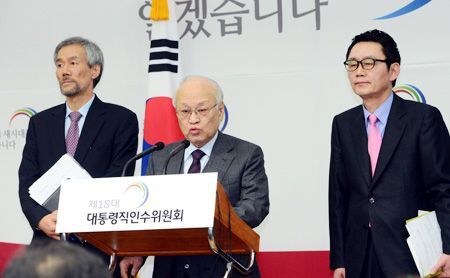
Kim Yong-jun, center, chairman of President-elect Park Geun-hye’s transition team, announces plans to reshuffle the government at the Korea Banking Institute building in Samcheong-dong, Seoul, on Jan. 15. At left is Yoo Min-bong, who chairs the team’s committee for planning and coordination of state affairs and at right is spokesman Yoon Chang-jung. / Yonhap
By Jun Ji-hye
Since the introduction of the five-year single term presidency in 1988, every incoming president has made one change or another to various government ministries.
They have consistently reorganized ministries regardless of their preferences for big or small government; restructuring, merging, dividing or sometimes renaming them entirely.
President-elect Park Geun-hye is currently pursuing the same approach.
Her transition team unveiled a restructuring plan early last week, the ninth such reorganization since 1988. As the public have witnessed such changes over successive governments they appear to be taking it for granted this time.
This is in contrast to the United States which has maintained the same government departments since 1988, with the exception of the creation of the Department of Homeland Security in 2011, set up in response to the September 11 attacks.
Similarly, Japan has also maintained the same format for 12 years since it overhauled the functions of its central government in 2001 for the first time in 50 years.
Park’s plans include the creation of the Ministry of Creativity and Science and the revival of the Ministry of Maritime and Fisheries Affairs.
Following the revival of the maritime ministry, the Ministry of Land, Transport and Maritime Affairs will have to be renamed to reflect the change in responsibilities envisaged under the incoming administration.
Other changes include changing the name of the Ministry of Knowledge Economy to the Ministry of Industry, Trade and Energy, which is expected to take over responsibility for trade issues from the Ministry of Foreign Affairs and Trade.
Also expected to be renamed is the Ministry of Public Administration and Security which will become the Ministry of Safety and Public Administration to emphasize, Park’s commitment to the safety of people, according to the transition team.
Efficiency
However, experts are concerned about the frequent changes, highlighting that it risks interference with continuity and stability in the conduct of state affairs.
“In principle, making changes too often does not make sense,” said Shim Ik-sup, a professor at the department of public administration at Dongguk University.
To prove his point he argued that throughout the last 300 years of public administration some specific ministries such as defense, foreign affairs and home affairs have remained in place in many different nations, pointing to the importance of continuity in state affairs.
“Most countries fundamentally have possessed these ministries since the birth of their governments. But the frequent renaming, merging and division of those ministries is just a backward behavior. For instance, public administration ministry is naturally supposed to take responsibility for home affairs. Its name, whether the word ‘security’ comes first or last, does not really matter,” Shim said.
He stressed the need for bipartisan consensus in the process of carrying out the process of reorganizing government machinery, in order to avoid such frequent changes.
“Before announcing the plan to the public and implementing it, the ruling and opposition parties need to discuss it thoroughly and agree that they will not reverse the decision even after their regime is changed after five years,” he said.
He added, “This will only make the government function well because it will guarantee continuity of the state’s affairs. A shake-up every five years is just a waste of energy.”
Yeom Jae-ho, professor of the department of public administration at Korea University, agrees in part with Shim.
He said, although minor changes can be acceptable, there are negative aspects of the frequent major changes in terms of the specific roles of these ministries.
Yeom raised a question about the decision to move trade supervision from the foreign ministry to the industry ministry.
“If the industry ministry carries out Free Trade Agreement (FTA) issues, there could be conflicts with the agriculture ministry as both sides deal with industrial affairs. In this regard, the foreign ministry acts as a good mediator between these ministries,” he said.
Cost
Wasting resources is another area of concern associated with debate over the restructuring of government. Renaming ministries means completely changing signboards and name cards of officials as well as the format of government documents.
Analysts estimate that the public administration ministry will need about 60 million won ($ 57,000) to change the logo on its signboard and website as well as the creation of a new official stamp.
The financial cost for embarking on the same renaming exercise for the Ministry of Land, Transport and Maritime Affairs is expected to be even higher, taking into account the need to change all road signs nationwide.
In 2007, then Ministry of Government Administration and Home Affairs came under fire for similar reasons. It spent about 10 billion won of the national budget, following a decision to change the name of 166 local offices for civic services from “Dong office” to “Community center.”
Professor Shim said that name changes will also not necessarily lead to more effective functions of government.
“Such changes might be seen as waste of money on useless things. What it is called is not that important. What is more important is content, not appearances,” he said.
He cynically added, “I even doubt if there are other names to replace them yet again.”
Indeed, if the 60-year-old President-elect’s restructuring plans are approved by the National Assembly, the Ministry of Public Administration will have its fourth name since 1948. The latest change was made by President Lee Myung-bak in 2008 ― from Ministry of Government Administration and Home Affairs to Ministry of Public Administration and Security.
Shim said that he receives many questions from foreign reporters whenever such changes are announced.
“They asked if the government of Korea had created something new and requested further explanations. But when I answered that it is basically just a change of name and the ministry was still in charge of the same affairs, they seemed unable to understand such a move. It is so embarrassing,” he said.
Ju Chang-bum, professor of the department of public administration at Dongguk University, also expressed skepticism about the issue, saying the frequent shake-up might hinder stability. He also added that this practice has a lot to do in part with the nation’s culture.
“For example, the Sonata by Hyundai Motor has been selling with the same name for a considerable period in the United States. But its name has been consistently changed in Korea because that is what people want,” he said.
The professor said, although there is criticism about government reorganization, sometimes it is unavoidable because people here tend to like and pursue change.
“If the President-elect does not change anything for the new government, people will be critical again and ask why there is no change. The public tend to think restructuring is the best way of reflecting a new president’s political philosophy and vision,” Ju said.
“Politicians are well aware of this and it leads them to always attempt to change the system despite some negative aspects such as the financial burden. For them, it can be a way of accepting a national demand,” he added.