ROK-Oman ties see remarkable boost since 1974
.jpg?w=728)
His Majesty Sultan Qabood bin Said
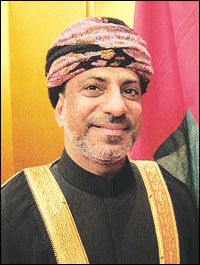
Omani Ambassador to Korea Mohamed Alharthy
The Sultanate of Oman is celebrating its 42
nd
National Day today under the leadership of His majesty Sultan Qaboos Bin Said, who led the process of the renaissance in the country with wisdom and abilities. The Omani citizens have formed cornerstone and the driving force through the years of modern renaissance in all fields.
The Sultanate is keen in education and providing various types of skills and knowledge to contribute to building qualifications of the human resources that meet the needs of the development in the present and the future.
A’Shura in Oman granted wider powers to strengthen the performances of parliamentary
Sultan Qaboos is keen on keeping the Omani citizens as the real partners of the government in the process of the development for serving the society. The establishment of the Council of Oman (the State council and the Majilis A’Shura “Consultative Council”) was a remarkable sign for developing the Omani consultative system. The Council of Oman consists of the State council, which H.M. appoints its members among the best Omani with experiences and the A’Shura Council, which the Omani people elect their representatives from all the (Wilayat) provinces. The Council received a range of legislative and regulatory powers.
Oman is state of institutions
This year is a remarkable point in history; the modern Omani judiciary enjoys a complete independence. Institutions and laws were completed too. The amendments of the Basic Law of the State responded to the aspirations of the Omani citizens in the national development efforts and strengthen the parliament’s legislatives that contributed to achievement of development and prosperity. The Basic Law of the State is representing the legal frame for the society and the basic foundation of the work, role and governor of State’s institutions.
In this contest, the Sultanate is in the second place among the Arab states that provides the judiciary a complete independence from the executive power. This reflects the interest of the H.M. to achieve the interests of the country and the citizen as well.
Security and tranquility to achieve national development
The Sultanate of Oman enjoys a fertile environment for security, safety and stability in this vital region of the world. The Sultanate achieved advanced rank in Global Peace Index as it is the most secure country in the Middle East and Africa, and also it came fourth in rank on the Arab and the 41st in the worldwide according to the report issued by Australia Institute of Economic and Peace in 2011, which included 153 countries all over the world.
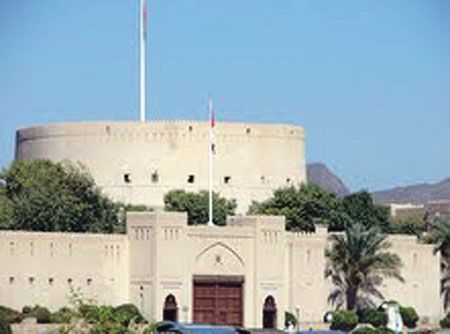
Nizwa castle and market
Tolerance is prominent feature of Oman personality
The Omani identity is characterized by the ability to communicate with others. It embodies in the interrelation, interdependence and cohesion between the Omani societies that are the fundamental pedestal of the prosperity. The Sultanate relationships with other nations are based on dialogue, friendship and respect for freedom of religion and belief.
Based on its civilization, the Sultanate of Oman rejects all forms of intolerances and calls for understanding of various civilizations in opinion, religion and culture in general.
The Basic Law of the State ensured personal freedom and allows its practice within the law. Likewise, the Omani Personal Status Law grants non-Muslims the right to practice their religious rites under the protection of the law.

A view of Muscat, the capital of Oman
Foreign policy of the Sultanate of Oman
The foreign policy of the Sultanate reflects the personal Omani features and the historical experience with wise leadership. This policy builds bridges of friendship, opens prospects for cooperation and good relations with various countries according to the firm foundations of mutual respect and respect neighborly relations.
As for these foundations, the Sultanate managed to build close relationships with states and other nations. Therefore, foreign Omani policy becomes a field to support the efforts of economic and social development and to achieve peace, stability and tranquility. It is marked by clarity in dealing with others.
In the area of human rights, the Sultanate managed to establish appropriate legal basic structures at the national level in a bid to implant human rights principles as part of its national legislations and institutions. The Sultanate's universal period review affirms its commitment to international standards in the field of human rights as its national report enjoyed an international commendation on Jan. 26
th
, 2011 before the Human Rights Council.
Within this context, the joint businessmen councils are active and the Chamber of Commerce and Industry participates in the membership of the Sultanate's visiting delegation to other countries. Also, friendship associations and commissions’ dialogue and strategic understanding are active with several friendly countries. Many economic and trade relations recorded broad activity with many countries, such as Japan and Brazil. The Sultanate has diplomatic relations with more than 150 countries in the world, and participates in the membership of more than 105 regional and international organizations.
Stability of the economy in the Sultanate of Oman
During 2012, the Sultanate focused on a number of economic goals like the total economic stability. The total economic stability tackles major issues in the state including inflation and the rate of jobseekers. It also seeks to increase welfare of the community by achieving stability in the general level of prices, providing jobs and justice in the distribution of income and achieving the possible amount of the gross domestic product (GDP) and the national economy.
The state's general budget for 2012 strives to achieve a balance between income and expenditure; provide more job opportunities for citizens; give greater attention to education and training and maintaining the inflation rate in the same level in 2011; continue to implement the strategy of economic diversification; support the non-oil productive sectors including expanding the productive base of the economy and job creation; and complete the implementation of infrastructure projects, such as airports, ports and roads.
In the international reports, the Sultanate's economic policies received an international praise reflecting its good infrastructure, macroeconomic stability and the level of healthcare and education. The Sultanate obtained the eighth level in the Arab world and 89th globally in the Human Development Index for 2011 issued by the United Nations Developmental Program.
Besides, the Sultanate achieved the fourth place in the Arab level and 32nd globally in Global Competitiveness Report for 2011 - 2012, which included 142 countries. In this report, the Sultanate ranked 16
globally in institutional framework. It achieved the third place globally in the general economic climate and ranked 28
in the infrastructure and was ranked the 23
rd
in the efficiency of markets, and ranked 30
in the efficiency of the capital market index.
In the economic freedom report in 2011, the Sultanate ranked 28
internationally classified within the best top 30 countries that enjoy economic freedom in the world. The Sultanate ranked fifth in Arab Networked Readiness Index for 2012 as part of the report of the Global Information Technology issued by the World Economic Forum.
The Sultanate has worked to attract investment over the past years by finding a suitable climate to attract foreign investments and stimulate domestic businessmen. It improves the economic environment and creates encouraging incentives because this vital sector is considered as one of the tributaries that the Sultanate relies on in the area of economic diversification.
The Sultanate enjoys many investment features, which has enabled it to attract domestic and foreign investment, including security, political stability, and the application of a free economic system. It allows foreigners to own projects by up to 100 percent without any restrictions on the transfer of funds to the outside, and there is no tax on the income of individuals. Also, it unifies the tax treatment to all companies, both Omani and foreign institutions to be 12 percent annually.
Stemming from the importance of promoting the role of the private sector in the development, the Sultanate sought to join bilateral conventions that allow increased commercial exchange with many countries of the world and encourage mutual investment. The Free Trade Agreement with the United States and the Sultanate's membership in the World Trade Organization contribute to increase the trade exchange with various countries of the world.
Economic zones in the Sultanate
The Sultanate of Oman began in 2011 a new phase in the establishment of free zones through establishing the Special Economic Zone Authority in A'Duqum, which was established by the Royal Decree No. (119/2011) issued on Oct. 26, 2011. The Special Economic Zone Authority at A'Duqum was designed to be a city based on the principles of environmental sustainability.
Up to now, there are three free zones in Oman they are: 1) Al Mazyounnah zone, which is located in the Dhofar Governorate, which started in 1999. 2) The free zone in Salalah is established in 2006. 3) The free zone in Sohar, which was established on Dec. 20 2010.
Tourism sector in the Sultanate of Oman
In recognition of the advanced position for the tourism sector in the Sultanate, Muscat was selected as the capital of Arab Tourism in 2012. The Ministry of Tourism has organized many events and activities that highlight the features of tourism potentials that are abound in the natural Omani environment and cultural heritage.
Thanks to the Omani civilized efforts, Muscat has joined the top 10 cities in the world well worth a visit for 2012, according to the website guide “Lonely Planet,” Muscat ranked in the second place after London which ranked in the first place. Muscat is one of the world famous places in the travel and tourism sector as evaluated by the British Broadcasting Corporation. Fortunately, this estimation coincided with the nomination of Muscat as the Arabian Tourism Capital for 2012. The Sultanate is pursuing efforts to promote the geological tourism due to the various geological elevations and landscapes that the country enjoys, beside the adventure tourism for those who like climbing mountains, camping in the soft desert sand and diving in the beautiful beaches.
Oman- Korea relations:
Oman- Korea relations go back to more than a thousand years, when Omani merchants met their Korean counterparts on their way to China. In modern times, they established diplomatic relations in 1974. Since then, Oman–Korea relations witnessed a remarkable development in various fields.
Korea is regarded as a major trading partner of Oman, and in the presence both countries engage in numerous economical exchange and cooperation. Oman provides large quantities of Oil and LNG to Korea: on the other hand, Korea exports many industrial products, including automobiles, vessels, hi-tech electronics and electrics to Oman.
Moreover, many Korean companies such as GS constructions, Dawoo International and Doosan Heavy Industries contributing to the development of Omani infrastructure and other major projects.
In 2011, Oman’s exports to Korea reached about $ 5.4 billion, while the Korea’s exports reached $907 million.
It is important to mention here that the Oman-Korea Joint Committee is playing a very pivotal role in promoting and developing cooperation between the two countries. During the third round of the meetings which was held in Seoul Nov.12-13 this year, they discussed many topic of mutual interests such as trade, investment, information security, health, renewable energy, electricity and water, railways, vocational education, maritime transport etc..
During this meetings the KCCI, Ministry of Knowledge Economy and the Embassy of the Sultanate of Oman in Seoul organized an investment forum, which attended representatives of more than 80 Korean companies seeking to enter the Oman markets.
On May 25, a new building of Oman Embassy officially opened in Seoul, which will play an important role in enhancing the relation and cooperation between the two countries.
To reflect the strong ties, some Omani high delegations visited Korea during this year including the visit of H.E Minister of Education, H.E. Minister of Interior, H.E. Minister of Agriculture, H.E Minister of Transport, H.E Minister of environment and Climate Affairs. From the Korean side H.E. the prime minister visited Muscat in January 2012.
Also some 100 Omani students visited Korea this year in the frame of students exchange program.
To promote cultural exchange, the Embassy of the Sultanate of Oman in Korea participated in various events such as Hi-Seoul, the Arab Cultural Festival. In addition, it organized some cultural events including Omani costume showcase, Omani folklore music in three places in Seoul such as Tech-mart area in downtown, Sincheon Rotary and Lotte Hotel.
In the context of growing relations between the two countries, the Sultanate participated in Yeosu Expo 2012 with a pavilion under the theme “Conservation of the Marine resources,” winning the golden prize for the best pavilion in the field of embodying the
slogan
of the
exhibition
. Also it attracted more than half million visitors.