Legislation ministry chief vows support for Asian countries
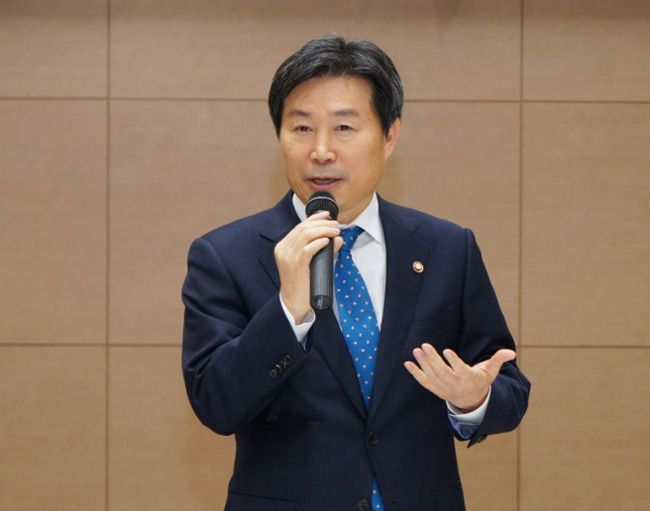
Minister Je Jeong-boo
By Kim Jae-kyoung
South Korea will step up efforts to export its legislation system to developing countries, according to Korea’s Minister of Government Legislation Je Jeong-boo.
Je said that he will place a top policy priority on globalizing Korea’s advanced legislative system to boost bilateral cooperation and pave the way for Korean firms to strengthen their footholds in the burgeoning markets.
“The role of a legislative system as intangible social infrastructure for national development has become more important than ever,” he said during a recent interview. “Sharing Korea’s advanced legislative experience with our Asian neighbors will help them design systems for their development and create a foundation for common, sustainable growth.”
He pointed out that exporting Korea’s legislative system will make it easier for Korean firms to do business overseas.
“I anticipate that Korean companies in other countries will be better able to actively invest in local markets, if the host countries offer legislative systems similar to that of Korea,” he said.
Je plans to focus on Southeast Asian markets first as many Asian countries are deeply interested in Korea’s experience.
“Southeast Asia will become the base from which legislative hallyu will expand worldwide,” he said.
“Once we achieve success in Southeast Asia, we will reach out to developing countries in Africa and Latin America through Central Asia and the Middle East.”
To that end, a Korean delegation led by Minister Je visited Myanmar and Vietnam from late August to early September.
The legislation ministry is seeking to support improvements to the legislation system in Vietnam, while agreeing to introduce Korea’s law information centers and other IT infrastructure to Myanmar.
“Myanmar’s state organizations are already eager to learn about the Korean legislative system. This is a great sign for Korean law firms present in Myanmar,” he said.
“If Myanmar’s legislative system moves closer to that of Korea, Korean companies will be able to plan their expansion into Myanmar more efficiently, and easily access information there through the legislative information system we will have built.”
On Nov. 1, the ministry will host the Asian Legislative Experts Symposium (ALES) in Seoul, inviting participants from public, private, and academic sectors in Asian countries including Laos, the Philippines and Vietnam.
In the long term, the ministry plans to expand its globalization drive from Southeast Asia to Africa and Latin America by signing more memorandums of understanding (MOUs) to transfer its support programs.
“We will try to bring Korean-style legislative systems to Africa and Latin America by entering into MOUs on exchange and cooperation with developing countries in the regions, such as Tanzania and Colombia, which are deeply interested in learning from Korea’s social and economic development experience,” Je said.
So far, Korea has signed an MOU for legislative exchange and cooperation with 19 organizations in Uzbekistan, Kazakhstan, Cambodia, Laos and nine other countries.
Je stressed that there are a couple of reasons why Korea’s legislative information system is gaining popularity in Southeast Asia.
He cited “people-friendliness” as the top factor, noting that it is the only service in the world that provides information related to all laws.
Je added that another unique feature of Korea’s system is that it provides information related to enforcement of law, such as legal interpretations, administrative judgments, Supreme Court rulings and Constitutional Court rulings.
Lastly, the Korean legislative information system can be combined with IT infrastructure and smartphones to allow people to look up laws from anywhere they want to, he said.