Kang Seung-woo is the Business Desk editor at The Korea Times. Prior to this position, he covered politics, national affairs, finance and sports.
'Apologies and remorse should be translated into action'
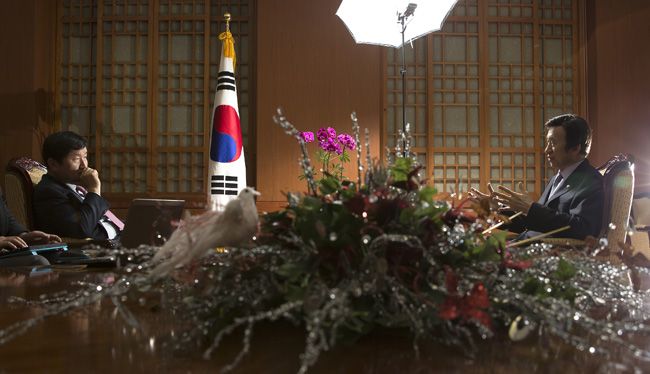
Foreign Minister Yun Byung-se, right, speaks with Korea Times Chief Editorial Writer Oh Young-jin during a recent interview at the Ministry of Foreign Affairs in Doryeom-dong, downtown Seoul. / Korea Times photo by Choi Won-suk
By Kang Seung-woo
The following are questions and answers from a recent exclusive interview The Korea Times had with Foreign Minister Yun Byung-se. — ED.
Q: Do you think competition and geopolitical rivalry will best describe the U.S.-China relationship in the near future? If that is the case, how can Korea remain friends with both nations and get the most out of it? If Korea were forced to choose between the two, what should be its option?
A: It can be said that there are elements of both cooperation and competition in the U.S.-China relationship. However, as I made clear on many occasions over the past year, viewing U.S.-China ties as a zero-sum relationship does not fully reflect reality. I am aware that some view the U.S.-China relationship through the prism of geopolitical rivalry. However, as we saw at last year’s Strategic and Economic Dialogue between the U.S. and China, both countries are working together across the board on numerous issues. Even on issues the two countries don’t see eye to eye on, such as the South China Sea and cyber security, it has not necessarily been a physically confrontational relationship. Naturally, regional countries, including Korea, prefer to promote the cooperative aspects between Washington and Beijing.
Korea-U.S. and Korea-China relationships are not zero sum either. Korea enjoys close ties with both the U.S. and China. President Barack Obama, Secretary of State John Kerry as well as the U.S. Congressional Research Service have said that the Korea-U.S. alliance is at the best state ever. At the same time, the strategic cooperative partnership between Korea and China is growing stronger than ever, as you could see from the recent Korea-China FTA.
Nurturing good ties with both the U.S. and China is not an easy task, but Korea has demonstrated its wisdom and capability to do so even when there have been divergent attitudes on certain core issues such as the AIIB and the South China Sea, among others.
President Obama has said that Seoul’s good ties with both the U.S. and China are completely compatible. Last October during President Park Geun-hye’s visit to Washington D.C., he said the U.S. encouraged Korea to have a strong relationship with China.
Q: North Korea claims it has developed a hydrogen bomb. How can South Korea and the international community prevent Pyongyang from continuing to develop related programs?
A: North Korea’s WMD programs, whether nuclear, biological, or chemical, are a clear and present threat not only to the peace and stability of the Korean Peninsula and Northeast Asia, but also to the global non-proliferation regime. That is why the United Nations Security Council has adopted four resolutions and has imposed robust sanctions against Pyongyang. Now, with the historic agreement on the Iranian nuclear issue, North Korea remains the only country under U.N. sanctions because of its nuclear programs. The international community is firmly united on this. Last year, the U.N., the East Asia Summit and individual countries, including China’s President Xi Jinping, have sent an unequivocal message that North Korea’s nuclear weapons programs are unacceptable.
North Korea is paying a heavy price in the form of diplomatic isolation and economic difficulties. North Korea needs to understand that nukes do not guarantee security, but rather that the opposite is true. Pyongyang is under the illusion that it can simultaneously develop its nuclear programs and its economy. But it cannot have its cake and eat it too. Over the past year, we have seen the winds of change reach other parts of the world, such as Cuba, Iran and Myanmar. Now it is time for Pyongyang to learn lessons from them. I hope that North Korea will make a right choice and stand on the right side of history. The international community will continue to stand united until it will do so.
Q: Don’t you think we’ve regarded North Korea’s nuclear programs as something that will go away with time and have approached the issue somewhat passively?
A: As I have just said, the international community is more firmly united than ever against North Korea’s nuclear weapons programs. In 2015, we sent more than two dozen robust messages to North Korea at various high-level meetings and international conferences, the strongest ever. This includes the Korea-U.S. summit, Korea-China summit, the Korea-EU summit, the U.S.-China summit, the ASEAN related summits, as well as the ASEM and MIKTA Foreign Ministers’ Meeting. In particular, I would like to remind you about President Park Geun-hye and President Barack Obama’s joint statement on North Korea in October last year, where they agreed to address the problem with the utmost urgency and determination.
Following last year’s agreement between Iran and the P5+1, the eyes of the world are now on Pyongyang, and the international community will not let down its guard. An instructive lesson from the Iranian case is the importance of international unity and dialogue. The five parties are firmly united, and the government has been making unceasing efforts to resume meaningful Six Party Talks. We have come up with some initiatives, and the five parties’ responses have been positive. As a follow-up measure to the Korea-U.S. summit, we will hold high-level bilateral consultations with the U.S. in the near future. And as I have previously mentioned, we will push for various forms of consultation, including trilateral processes, and keep the door open for inter-Korean dialogue on the North Korean nuclear issue.
Q: How would you refute a remark made at a U.S. presidential election campaign that Korea is enjoying a free security ride on the back of the U.S.?
A: Last October, on the eve of President Park Geun-hye’s visit to Washington, Secretary of State John Kerry and I said in our joint op-ed that ours is a partnership built to last. Last November, the Department of Defense Spokesperson Jeff Davis also pointed this out, saying that “our commitment has been long-term; it’s been enduring. It has stood constant, regardless of whom the president was, regardless of which party was in power, and I don’t see that changing.”
The Korea-U.S. alliance has been the anchor for security, stability and prosperity in this part of the world and beyond, as clearly stated in the National Defense Authorization Act of 2016. And as you can see from the leaders’ Joint Declaration commemorating the 60th anniversary of the Korea-U.S. alliance and the Joint Statement of the 2+2 Foreign and Defense Ministers’ meeting, Korea is a valued partner for peace and stability on the Korean peninsula and within Northeast Asia. This demonstrates that the view you mentioned is not the prevailing view in the U.S.
Moreover, Korea and the U.S. are now developing a global partnership that encompasses not only security, but also the economy and new frontiers of cooperation. We are working together in various fields including global health and cyber security, as well as global issues such as peace-keeping, development cooperation and climate change, to name a few.
Finally, I would also remind you that in order to provide a stable environment for the U.S. forces in Korea, who play a crucial role in our alliance, the Korean government has been sharing the burden, a contribution highly appreciated by the U.S. government.
An activist puts her arm around a girl statue symbolizing a “comfort woman” in front of the Japanese Embassy in Seoul, Saturday, during a rally to protest an agreement between Korea and Japan to end their dispute over Tokyo’s sexual enslavement of Korean women before and during World War II. / Yonhap
Q: What are your views on claims that we are not anywhere near inter-Korean unification even after President Park Geun-hye’s reference to unification as a “bonanza”? Can an inter-Korea summit be possible within the remaining two years of Park’s presidency?
A: When you address unification, you need to approach it from three aspects, international, inter-Korean and domestic. As foreign minister, my mandate is mainly to foster an international environment conducive to unification.
Over the past two years, we have seen much progress made in this regard. Since President Park Geun-hye’s speech in Dresden in 2014, we are witnessing growing awareness, both at home and abroad, on the need for and benefits of Korean unification. For example, the international community, including the U.S., China, and ASEAN, has expressed unprecedentedly strong support for our unification efforts. And last year in Davos, after I spoke about the “Journey to One Korea,” I was deeply struck by the strong support from members of the international audience, who said they now believed that Korean unification is not only necessary but also doable. Many people now see the benefits that unification will bring, not only for Korea, but for the wider world.
In addition to promoting international support for unification, we are working on the domestic and inter-Korean levels as well. We have set up the Presidential Committee for Unification Preparation, and recently we had high-level inter-Korean talks for the first time in eight years, which ended without tangible outcomes. We need to keep the doors open for inter-Korean dialogue, as the unification ministry responded to the North Korean leader’s New Year’s address.
On the possibility of an inter-Korean summit meeting, we need to remind ourselves that there is a lack of regular dialogue. Given such circumstances, it is important to nurture favorable conditions for substantive dialogue. In inter-Korean relations, the right track is the fast track.
Q: Should the Korea-Japan agreement over “comfort women” be seen as a step forward compared to the Kono Statement?
A: In the past there were some statements and partial measures from the Japanese side to address the “comfort women” issue. For instance, the Kono Statement and the Asia Women’s Fund each tried to deal with certain aspects of the issue in reaction to strong voices from Korea and the international community. A more recent effort was the unofficial yet well-known “Sasae proposal” of 2012 that aimed at a relatively comprehensive approach, and even in comparison with that latest proposal, this agreement clearly marks an advance forward, as it includes the following key aspects.
First, the Japanese government, for the first time, has acknowledged its responsibility without adding qualifiers. In the past, letters from Japanese Prime Ministers and the Presidents of the Asian Women’s Fund to the victims only mentioned a “moral” responsibility.
Second, Prime Minister Shinzo Abe, in his capacity as Prime Minister of Japan, expressed his sincere apologies and remorse from the bottom of his heart to all the victims. In the past, previous proposals suggested an apology in the form of an unofficial letter to individual victims. This agreement is meaningful as the Prime Minister’s apologies were expressed in a public and official manner, and in an unambiguous and unequivocal way, including the telephone conversation between the two leaders.
Third, it is important that apologies and remorse should be translated into action through a faithful implementation. Previous attempts were not successful because they used private funding for the victims. This time, however, the Japanese government will contribute from its budget funding to help restore honor and dignity and to heal the wounds of the victims, among other goals.
Last but not least, we now have a creative formula, a foundation established by the Korean side and funded by the Japanese government, to ensure the agreement’s sustainable implementation.
But like the saying goes, the proof of the pudding is in the eating. What is important is that the agreement needs to be implemented faithfully. In particular, it is crucial that there is no backtracking or undermining of the unequivocal expressions made in front of the international community.
Q: Will the Korea-Japan agreement over “comfort women” be a turning point in the bilateral relationship?
A: The “comfort women” issue has been one of the most difficult history-related issues between Korea and Japan. President Park Geun-hye, Prime Minister Shinzo Abe, Foreign Minister Fumio Kishida and I all hoped that this agreement will provide us with an opportunity for a new chapter in Korea-Japan relations.
At this stage, what is important is the faithful implementation of this agreement. With the implementation of the agreement in full, we hope we can create a virtuous cycle for the bilateral ties.
Until now, we have taken a “two-track approach” on our ties with Japan. We have taken a firm and principled position on issues related to history while continuing and developing cooperation in many other fields. The faithful implementation could reinforce our efforts on fields where cooperation has been on track, and it could also fill the gap in areas where progress has been slow. So again, let me emphasize that the proper implementation is the best measure of any agreement.
Q: Do you think the compromise over the “comfort women” has paved a way to resolve a string of remaining historical disputes between Korea and Japan, such as the use of forced Korean labor during the colonial era, on a case-by-case basis over the so-called package deal?
A: The outstanding issues between Seoul and Tokyo are complex, and each issue needs to be considered on its own nature and merit. As such, it is premature to make predictions on whether this agreement will have a domino effect on other sensitive pending issues. As the “comfort women” issue has been a major contentious issue for decades, it is hoped that the faithful implementation of the agreement will help build up trust and can lead to a virtuous cycle.
During the past two decades, we have seen a pattern of Korea-Japan ties starting on a good footing at the beginning of an administration, then going worse mid-term and ending up hitting rock bottom. The Park Geun-hye administration has been trying to make a break from such a pattern, so we hope that it will be helpful in terms of that aspect as well.