Korea needs new education model
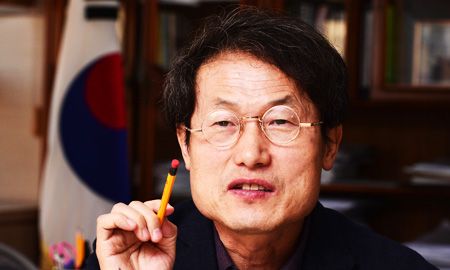
Cho Hee-yeon, superintendent of the Seoul Metropolitan Office of Education, speaks during an interview with The Korea Times at his office in Seoul on Nov. 4. / Korea Times photo by Shim Hyun-chul
By Chung Hyun-chae
Seoul’s top educator says it is time to take a new approach that brings hope for the city’s students.
“We have to take a new path, a ‘hope of education,’ as the country has become one of world’s 20 major economic powers,” said Cho Hee-yeon, superintendent of the Seoul Metropolitan Office of Education.
He pointed out that schoolchildren have been engaged in excessive competition to enter prestigious universities.
“Such a competition-driven education system is outdated and should be turned into an egalitarian system that can cultivate students with diversity,” he told The Korea Times.
The education chief explained that a new system was needed to provide customized education for each individual to foster creative thinking and problem-solving capabilities.
Cho also revealed a plan to help children become global citizens who have an open mind and esprit de corps so they can work and live with other nationalities.
For this, the education office is pushing for an “open global citizens training program” in collaboration with the Asia-Pacific Center of Education for International Understanding (APCEIU) under the auspices of UNESCO.
“Our goal now is to nurture children as individuals who live together without a hierarchy, helping them develop their creativity and maximize their potential.”
He downplays critics’ claims that his egalitarian policy might lead to a decline in students’ overall academic performance.
“When our country was developing fast in the 1960s-1980s, our education was aimed at chasing the advanced countries,” Cho said.
He added that students learned by rote under a standardized education system designed to produce a workforce necessary for rapid economic growth and modernization.
Now he strongly believes such an education method is outdated and cannot hold water in the information age of the 21st century.
Cho, who describes himself as an education chief who challenges inequality in education, said ordinary schools, not elite schools, should take the lead in putting “hope of education” into practice.
This is why he is so adamant about narrowing the education gap by beefing up ordinary schools.
“Public institutions are responsible for ensuring equal opportunities for all students, regardless of their socioeconomic backgrounds,” Cho said.
“There are few stories of students rising from ‘rags to riches’ nowadays because it’s almost impossible for children from underprivileged families to have a better education than those from rich families,” he pointed out.
“That’s why we have to provide more administrative and financial support for ordinary schools to bring hope to students.”
He stressed that education should facilitate social mobility by giving equal opportunities for students to be successful.
“I do not think special education for the gifted is unconditionally wrong,” he said. “But I’m sure that ordinary schools should be at the heart of public education. Elite schools can ‘live together’ only after that.”
Cho has promised to increase the number of innovative educational districts from two to 12 as part of efforts to realize his equal education policy.
Innovative educational districts are expected to be generally in underprivileged regions. The education office and municipal authorities would support them, he said.
Cho was a professor at Sungkonghoe University before he was elected Seoul’s top education administrator in the June local elections. He has been an outspoken advocate of civil rights and equal education.