Robert Neff has authored and co-authored several books, including Letters from Joseon, Korea Through Western Eyes and Brief Encounters.
Giuseppe Santori: An Italian castaway on Jeju (Part 3)
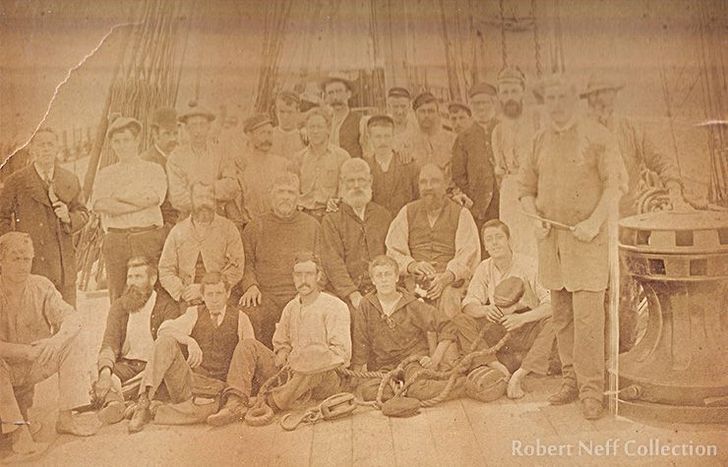
The crew of an unidentified ship in the late 19th century.
By Robert Neff
For the five survivors of the Bianca Pertica, the lifeboat they managed to clamber into was nothing but a tenuous sanctuary. The wind howled around them, driving the rain like daggers into their exposed flesh and the towering waves crashed over and over on the small boat, threatening to sink it.
They were at the mercy of the unforgiving sea and there was no time to lament the losses of their shipmates and worldly goods ― time was a luxury they did not possess.
As senior man, chief mate Cesare Paoli took charge and directed the men to start bailing water from the boat with anything they could find ― empty containers or their hands. He assured them that all was not lost and that the wind was actually a boon as it was blowing them toward Jeju Island. All they needed to do was to continue bailing and soon they would find shelter.
Throughout the night they bailed but it seemed almost a hopeless task. Every bucket of water bailed was just as quickly replaced by a wave crashing over the side. Desperation kept them at their task but they had not slept in more than two days and one by one they fell into an exhausted sleep.
It was the huge wave that struck and overturned their boat that brought them back to consciousness. Desperately, they clung to the sides of the boat as it was whipped about by the churning sea. Paoli, probably the oldest of the men, was the first to lose strength and, despite the efforts of his companions, lost his grip and was swept away.
The sea seemed to taunt and play with them. A wave, perhaps guided by the hand of Neptune, righted the boat allowing the men to haul themselves aboard. Chelini, “more dead than alive,” would have perished had not his comrades helped him into the boat.
Except for the will to survive, they had nothing ― no food or water and not even oars to paddle the boat. There was, however, no time to dwell on their losses. Although the storm had weakened, the endless pounding of the waves still threatened to sink the boat.
Throughout the night they bailed water with their bare hands. They could spare little attention for Chelini, who was violently shivering, except to try to protect him from the elements but he soon slipped into unconsciousness. In the hours of darkness, just before daybreak, Chelini quietly passed from this world, leaving only three survivors.
The following morning (21st), the storm abated and they found themselves drifting in the ocean current toward Jeju. Paoli had told them the island was some 80 kilometers to their north and they should try to reach it if no other options were available.
That day and the following they continued to drift toward the island. Gone were the dark rain clouds and the cool winds, only to be replaced with a clear sky and a furious summer sun beating down on them mercilessly, blistering their skin with its heat and compounding the misery of their thirst.
Pilade Taddei, unable to endure the heat and thirst any longer, became “very ill and delirious.” He raved with visions that only he could see and frequently called out, which added to the misery of his fellow survivors. Perhaps it was merciful to all that he died the following day.
Finally, on the 23rd, land (probably Mount Halla) was sighted some 40 kilometers in the distance, but almost mockingly the wind changed direction. The lifeboat was no longer drifting toward the island but, in fact, drifting away from it.
“As we had no oars, no sails, and no provisions of any sort, we did not know what to do,” recalled Santori. They could only stare at the island as they drifted further away.
The following morning the fickle wind once again changed direction ― back toward the island. In desperation, Santori and Leone Bacchione pried a long piece of wood from their boat and made a makeshift mast and a crude sail from their clothing and that of their fallen companions. It was probably at this point, in an effort to lighten the boat, they cast the corpses overboard.
Their efforts were successful and slowly the craft inched tantalizingly closer to the rocky shore. Nearly naked, they were cruelly abused by the beating sun that blistered their skin, and the salt from the sea mist only added to their misery. The shadow of their sail provided some relief but did nothing to quench the burning thirst that tormented them and threatened to drive them mad.
Progress was extremely slow. On the morning of the 25th, after nearly 24 hours of sailing with the makeshift sail, they were within 18 kilometers. The next morning they had closed to only 10 kilometers.
For six days they had been without fresh water and their lips were cracked, their tongues swollen and the desire for water outweighed reason. It seems almost ironic to suffer from thirst while on a vast body of cool water. For most, determination eventually gives way to temptation. Against Santori's hoarse protests, Bacchione, “unable to stand the thirst any longer, drank a quantity of saltwater, which did him much harm.”
Soon afterwards, the wind died, making the sail useless. Santori pulled down the makeshift mast and fashioned a paddle out of it and began to use it in an attempt to propel the boat to shore. Bacchione, who was retching and writhing in pain as his kidneys failed, assisted until his condition worsened to the point he no longer had any strength and collapsed at the bow of the boat. Delusional and burning with fever, he died later that night, leaving Santori alone.
[This is a revision of an earlier article that appeared in the RAS Transactions in 2007] Robert Neff has authored and co-authored several books including, Letters from Joseon, Korea Through Western Eyes and Brief Encounters.