'NK has 200 mobile launchers'
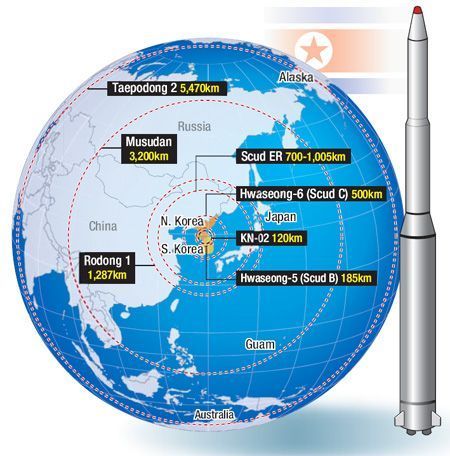
The graphic shows the composition of missiles by their striking distances on the basis of a recent report by the U.S. Department of Defense to the Congress.
By Kim Tae-gyu
North Korea has increased the number of its mobile missile launchers to 200, almost double the previous estimate, according to a recent U.S. report.
The report by the U.S. Department of Defense (DoD) presented to Congress said that Pyongyang may have a maximum of 100 short-range, 50 Rodong and 50 Musudan missiles.
South Korea had suspected the North had up to 40 short-range missiles such as the Hwaseong-5 and Hwaseong-6, an upgraded version of the Soviet-era Scud B and C, 40 Rodong and 14 Musudan missiles.
The Rodong is a single-stage ballistic missile with a range of between 1,000~2,000 kilometers while the Musudan is an intermediate-range weapon with a range of 2,500 to 4,000 kilometers.
The mobile facility, called a transporter erector launcher (TEL), poses a big threat because it is hard to locate.
In contrast, missiles launched from fixed sites are vulnerable to attack as they can be easily spotted during launch preparation.
Seoul has kept an eye on the surprise attack-specific TEL. North Korea moved two Musudan missiles on TELs last month to its eastern coast, prompting the South to raise its alert readiness.
The U.S. report also estimated that the belligerent state is armed with 5,100 multiple rocket launchers, up 300 from South Korea’s white paper published in 2012.
In contrast, Pyongyang may have reduced the number of weapons designed and produced by the Soviet Union or China during the Cold War.
Compared to Seoul’s 2012 white paper, the number of tanks, armored vehicles and field artillery pieces went down by 100 each to 4,100, 2,100 and 8,500, respectively.
Fighters and transport aircraft numbers were also substantially reduced to 730 and 290.
Korea Defense Network head Shin In-kyun said that the U.S. DoD report was the most authoritative because it was based on the latest intelligence and therefore provides useful insight into the North’s military strategy.
“The North appears to be focusing on missiles while caring less about other weapons. Such an approach is in line with its strategy of increasing its capability for regional confrontations,” Shin said.
“Of note is, Pyongyang has so many Rodong missiles, to which nuclear warheads can be attached, and Musudan missiles that are believed to be able to reach the U.S. territory of Guam.”