President Moon stresses diplomacy with 'Big 4'
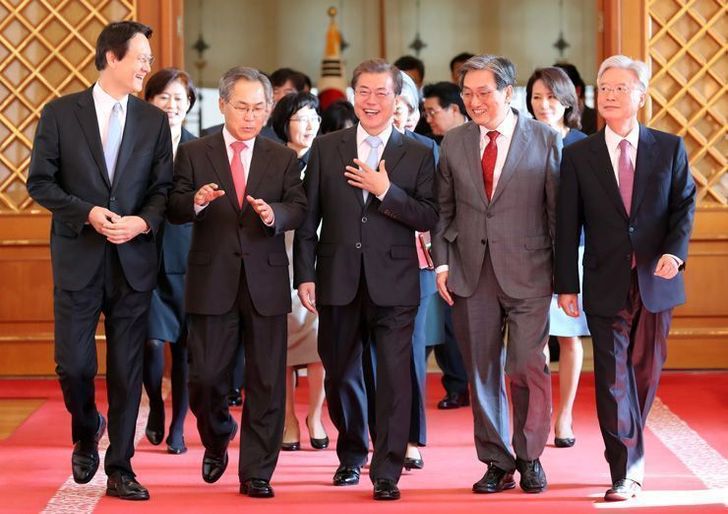
President Moon Jae-in, center, walks with the nation’s new ambassadors to four powerful countries after presenting credentials to them at Cheong Wa Dae, Wednesday. From left are Ambassador to Japan Lee Su-hoon, Ambassador to Russia Woo Yoon-keun, Moon, Ambassador to China Noh Young-min and Ambassador to the U.S. Cho Yoon-je. / Yonhap
President says ties with 4 powers more critical than ever
By Jun Ji-hye
South Korea’s diplomacy with four powerful countries — the United States, China, Russia and Japan — is more important than ever as the North Korea nuclear issue has entered a critical phase, President Moon Jae-in said Wednesday.
Moon made the remark during a ceremony at Cheong Wa Dae to present credentials to the country’s new ambassadors to the four nations.
They are Ambassador to Washington Cho Yoon-je, Ambassador to Beijing Noh Young-min, Ambassador to Moscow Woo Yoon-keun and Ambassador to Tokyo Lee Su-hoon.
Moon asked the new ambassadors to make every effort not only to seek diplomatic solutions to the nuclear issue, but to establish peace on the Korean Peninsula and in Northeast Asia.
“The United States, Japan, China and Russia are the backbone of our diplomacy,” Moon said. “I hope the four ambassadors will speak for South Korea’s new government at a time when it is shaping its diplomatic policy direction.”
Moon said Seoul needs to enhance its alliance with Washington to better cooperate in coping with North Korean threats, but also to resolve difficult problems including the renegotiation of the Korea-U.S. Free Trade Agreement (KORUS FTA) and defense cost-sharing.
Under his America-first policy, U.S. President Donald Trump has been putting pressure on South Korea, calling on the need to “renegotiate or terminate” the KORUS FTA. His trade negotiators have successfully started renegotiations with South Korean officials.
During his presidential campaign, Trump also pledged to have wealthy allies such as South Korea and Japan shoulder more of the cost of U.S. troops stationed in their countries.
“Likewise, the government needs to develop future-oriented relations with Japan to better cooperate on North Korean issues but also to resolve history matters,” Moon said.
Seoul and Tokyo have been sharing an uneasy relationship due to various history issues that occurred during the 1990-45 Japanese occupation, including Japan’s sexual enslavement of Korean women.
“We also need to overcome the Terminal High Altitude Area Defense (THAAD) problem to improve South Korea-China relations,” Moon said.
Seoul and Beijing have faced thorny relations following the former’s decision to host the advanced U.S. missile defense system designed to shoot down incoming North Korean ballistic missiles.
China has claimed the battery’s radar could be used to spy on the country’s military capabilities and carried out economic and cultural retaliation to protest the deployment.
With Russia, South Korea also needs to build cooperative relations to resolve the North Korean problem, Moon added.
In response, Cho said he will do his best to protect the nation’s interests in the upcoming renegotiations with the United States and strengthen the Seoul-Washington alliance.
For his part, Lee said he has maintained good relations with various Japanese figures while having participated in the so-called Track 1.5 semi-official discussions for the past decade.
“I will work to take Seoul-Tokyo relations one step forward,” he said.
Noh and Woo also vowed to work on improving relations with Beijing and Moscow, respectively.