Gaeseong companies face bankruptcy risks
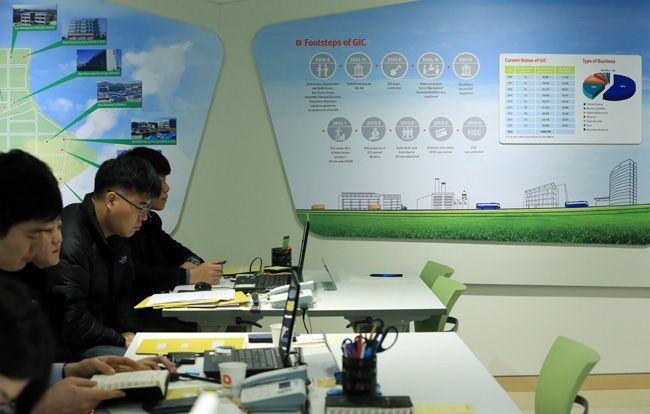
Officials work at the support center for businesses that operated in the Gaeseong Industrial Complex, Sunday, as the firms face snowballing losses following closure of the joint factory zone in North Korea. / Yonhap
By Yoon Ja-young
Companies that operated in the Gaeseong Industrial Complex (GIC) in North Korea are suffering growing losses after its closure. Many are expected go under if they fail to receive financial support at the right time from the government, officials said Sunday.
The impact will be deadly for the 124 small- and medium-sized companies that were expelled from the GIC, they said.
Because many of the companies made products solely in Gaeseong, some will have to close.
SnG, which supplies garments to around 20 companies, for instance, moved all its manufacturing to Gaeseong last April. The company invested 10 billion won in the GIC, hiring more than 900 North Koreans to produce 100% of its goods.
Hans Safety Shoes, which produces around 600,000 pairs of shoes a year, has manufacturing facilities in Daejeon and Gaeseong, but the latter was responsible for over 90 percent of total production.
Despite the geopolitical risks, many companies shifted production to the North Korean facility because of cheaper labor. The minimum monthly wage at Gaeseong was $74, with workers there earning on average $160 a month.
More than 70 percent of the companies in Gaeseong were textile and garment manufacturers, with most producing goods under OEM contracts. However, their buyers are likely to switch to other suppliers following the GIC closure.
When the complex was shut down for five months in 2013, businesses reported around 1 trillion won in losses. However, the losses are estimated to have been bigger when taking into account the damage to their reputation, and falling sales afterward.
To prevent them from going bankrupt, Strategy and Finance Minister Yoo Il-ho met heads of business lobby groups, Sunday, to discuss measures to support the companies.
The measures include deferring payment of taxes and public utility bills, such as electricity.
At the meeting, Yoo called for bigger companies to maintain business transactions and contracts with the firms.
“The government is making efforts to help the companies that operated in Gaeseong, but there are limitations,” he said, requesting that the whole business circle participate to help them.
Representatives from business lobby groups said they will ask their members to minimize making complaints to firms in Gaeseong while making settlements in cash as early as possible.
Businessmen say losses will be much bigger now than in 2013. Back then, they could take materials and finished goods from Gaeseong to South Korea, to continue production and sales. They cannot do anything now as North Korea has frozen all the assets, including materials, facilities and finished goods.
Shops that sell products manufactured in Gaeseong Industrial Complex are also facing huge damage. They were launched last September as a symbol of economic cooperation between the two Koreas, with five branches operating nationwide. Each has invested between 100 million and 300 million won to open the shop, but they will now have to close down.
“There are procedures for the government to follow even in shutting down a mom-and-pop store, such as prior notice and a hearing. The government is ignoring businesses,” said Chung Ki-sup, president of the association representing the firms that were based in the GIC.