Why elite Seoul apartment complexes are launching their own matchmaking clubs
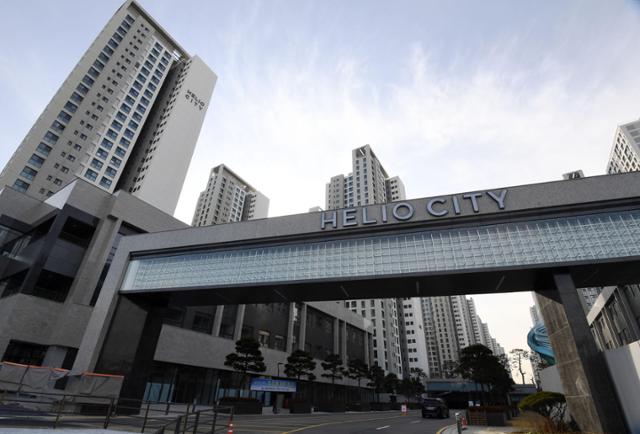
Helio City / Hankook Ilbo file
Matchmaking services named after ultra-luxury apartment complexes in southern Seoul are emerging, reflecting a growing trend in which a person’s address functions as a kind of social credential. At Helio City in Songpa and Raemian One Bailey in Seocho, resident-driven marriage networks have formalized into full companies — drawing both interest and criticism over what many are calling a deepening form of class-based dating.
According to industry officials, a matchmaking company named “Helio Marriage Information” officially opened in June inside the commercial area of Helio City, one of Seoul’s most recognizable high-end developments. The company, founded by a real estate agent with three decades of experience in Songpa District, attracted around 200 members within three months — about two-thirds of them Helio City residents, with the rest living in nearby complexes.
Helio City, which welcomed its first residents in 2018, is one of the largest apartment complexes in the country, boasting 9,510 households and strong transportation access. A unit measuring 84 square meters set a record this month, selling for 3.075 billion won ($2.2 million), underscoring the area's status as one of the capital's most prestigious addresses.
A similar phenomenon is unfolding at Raemian One Bailey, an upscale 2,990-unit complex in Banpo that has recently seen prices exceed 200 million won per pyeong (3.3 square meters). A resident-organized group created last December as an internal matchmaking circle served as the foundation for a company called “One Bailey Nobility” which formally launched in July.
While the resident-organized group only accepted residents, One Bailey Nobility expanded membership eligibility to people living across the Seocho, Gangnam and Banpo Districts. Membership fees vary widely, from annual plans that cost 500,000 won to premium options priced at 11 million won for two years.
Tower Palace in Dogok-dong, one of Korea’s earliest luxury high-rise residential complexes, is seeing similar developments. Residents recently formed a group to introduce single men and women within the complex, and the organizers are reportedly preparing additional gatherings for singles in neighboring luxury areas.
Public reaction to these apartment-based matchmaking networks is sharply divided. Supporters say such groups are practical because “identity verification is easy and people meet others with comparable assets,” boosting efficiency in the matchmaking process.
Critics, however, warn that creating marriage circles based on residential clusters risks entrenching class divisions. They argue that a closed marriage market formed around high-priced real estate could accelerate social stratification in a country where inequality and housing prices are already sensitive issues.
This article from the Hankook Ilbo, the sister publication of The Korea Times, is translated by a generative AI system and edited by The Korea Times.