Foreign residents choosing smaller cities over Seoul
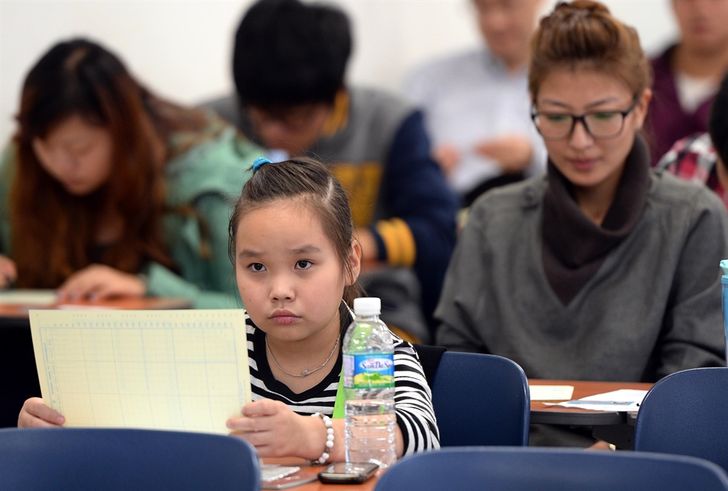
Foreign residents wait for the beginning of the Test of Proficiency in Korean (TOPIK) at Konkuk University in Seoul in this Oct. 20, 2013, file photo. / Korea Times photo by Cho Young-ho
By Jun Ji-hye
The foreign population concentrated around certain areas in Seoul has been dispersing across the country including into Gyeonggi Province, due mainly to increasing demand for workers in regional industrial complexes and agricultural villages, according to a research report released Wednesday.
According to the report issued by Chonnam National University's research center specializing in geography, foreign residents living in Seoul accounted for 30.8 percent of the total foreign population in 2010, but the figure fell to 22.7 percent in 2018.
The research center analyzed the Ministry of the Interior and Safety's data on foreign residents.
In Gyeonggi Province, the ratio of foreign residents there among the total foreign population increased from 30.3 percent in 2010 to 33.8 percent in 2018, while South Chungcheong Province has seen a 1.7 percentage point rise during the same period.
There were slight rises in the figures for Gwangju and Gangwon Province from 1.38 percent to 1.81 percent, and from 1.45 percent to 1.46 percent, respectively.
“The foreign population centralized around Seoul's Yeongdeungpo District has been dispersing into Gyeonggi Province and other parts of the country,” the report said. “This was because industrial complexes have been created in various parts of the country, and an increasing number of farming and fishing villages are looking for foreign workers.”
In 2010, the largest number of foreign nationals ― 37,000 ― within the total foreign population lived in Yeongdeungpo District, but the ranking of the district has slipped to fourth place with 49,000 foreign residents in 2018, after Ansan with 76,000, Suwon with 53,000 and Hwaseong with 52,000.
Ansan, Suwon and Hwaseong are all in Gyeonggi Province.
The report said there was a surge in the number of foreign nationals living in Hwaseong, noting that most there were those had the E-9 visa for low-skilled workers and worked at industrial complexes in the region.
The report added that the nationalities of foreign residents have diversified as well, saying the ratio of people from China has decreased while those from Vietnam and Thailand have increased.
“Although the nationalities, purposes of stay and settlement areas of foreign residents have diversified, Korea's foreign policy is still focused mostly on multiracial families in Seoul,” professor Kim Soo-jeong of Chonnam National University said. “Local administrations, not the central government, should take the lead in making more varied and segmented policies reflecting the characteristics of each region.”