Bahk Eun-ji has been with The Korea Times since 2012, building a career across multiple desks. She began at the Business Desk, where she conducted in-depth interviews with key figures in Korea's corporate world. Later, she moved to the Politics & City Desk, focusing on education policy and social affairs. She later served as team leader of the digital content team, leading curation efforts on the newspaper’s homepage and reshaping print stories for social media audiences to enhance digital reach. Now back on the Politics Desk, she covers the National Assembly and the Ministry of National Defense, with a renewed focus on political developments.
Short-term contract workers increase
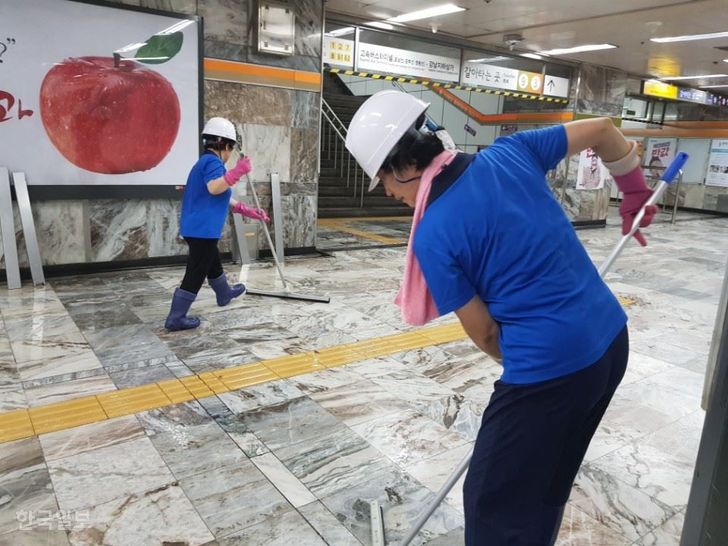
Short-term contract workers, who work fewer than 15 hours a week, have increased over the past 13 years. About 70 percent are women. Korea Times file
By Bahk Eun-ji
By Bahk Eun-ji
The number of part-time contract workers has more than tripled in Korea over the last 13 years, with about 70 percent being women, a study showed Sunday.
More companies are using such workers to reduce labor costs ― most of the workers are not entitled to severance pay, bonuses, leave and other benefits, resulting in polarization among workers.
According to a Korea Labor Institute (KLI) study based on 2017 data from Statistics Korea, about 679,300 people were part-time contract workers, employed for fewer than 15 hours a week.
They made up 3.4 percent of 20 million of paid workers. Their number also rose nearly 3.4 times from 198,900 in 2004.
About 71 percent of the part-time workers were women, of whom 45 percent were 65 or older.
“Companies seem to have increased employment of such part-time contract workers to reduce labor costs,” said Hur Jai-joon, a KLI researcher who led the study.
Under the law, companies do not have to provide national health insurance, national pension, employment insurance and workers' compensation insurance to these employees, nor severance pay and leave, according to Hur.
Only 9 percent of these workers were part of the national pension program, and 2.3 percent were covered by the state employment insurance. A mere 2.1 percent had a contract to receive severance pay, 6.9 percent for bonuses, 4.3 percent for overtime pay, and 1.6 percent to paid leave.
Their average pay was a little over 10,000 won an hour, and they usually held the job for a year.
Some experts have said the increase in part-time contract workers was a result of women's increasing participation in the labor market and switching from full-time jobs to more varied part-time ones.
However, more than 43 percent of the workers were engaged in jobs that require simple tasks such as cleaning and security work, and 22.7 percent were in the service industry.
“This can worsen polarization in the labor market,” Hur said in the study. “Part-time contract workers consist of different types of workers, so the government needs to support them with more customized policies.”
Another study by the Korea Institute of Public Finance also stressed various government policies to meet the more varied job types.
“The current labor safety net offers limited support to short-time contract workers, so it needs to be more linked to welfare policies,” the report said. “The government has to come up with support measures for those who are underemployed.”