Kim Hyun-bin began his journalism career at Arirang TV from 2012 to 2017, specializing in defense, foreign affairs and the economy. In 2018, he joined The Korea Times, covering society and business, and is currently responsible for embassy affairs.
Budget airlines beefing up fleets
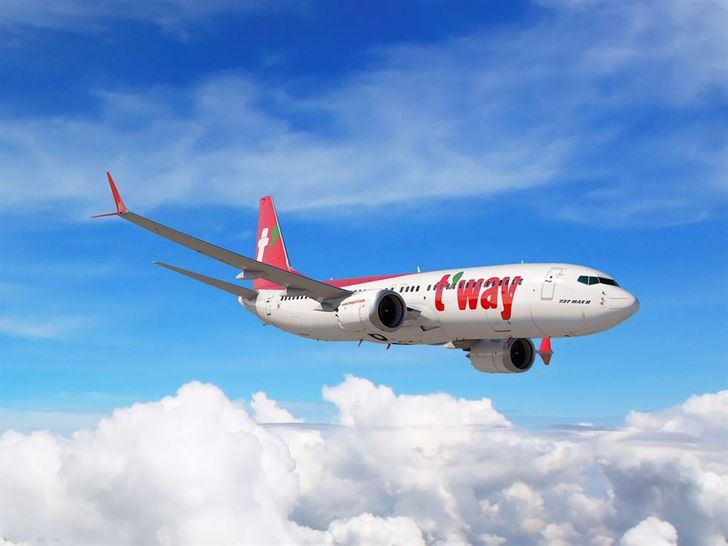
T'way Air's Boeing 737 MAX 8 in flight / Courtesy of T'way Air
By Kim Hyun-bin
By Kim Hyun-bin
The local budget carriers ― once a non-factor in the airline industry ― have expanded their footprint as they have become almost as large as the nation's No. 1 flagship airline last year, according to the transport ministry, Thursday.
According to the Ministry of Land, Infrastructure and Transport, low-cost carriers operate 140 planes in 2018, compared with 167 by Korean Air. Asiana Airlines, another of the nation's full service carriers, operates 83.
Among the budget carriers, Jeju Air was the largest player in the industry with 40 planes, followed by Jin Air with 27, Easter Jet with 22, T'way Air with 24, Air Seoul with seven and Air Incheon with three.
Jeju Air added the most planes to its fleet with nine, followed by T'way Air with five and Air Busan, Eastar Jet and Air Incheon.
In November, Jeju Air inked a $4.4 billion deal to acquire 40 new Boeing B737-MAX planes, with delivery set to begin in 2022. Other budget airlines have followed suit, purchasing their own new planes.
The ministry report also revealed that 43 planes were registered in 2018, 29 of which were commercial planes and 14 non-commercial, with 19 out of 29, or 66 percent, acquired by LCCs.
In 2008, there were 447 registered commercial aircraft, but the number has surged continuously each year creating an 86.8 percent growth in the last decade. Many experts predict with this current rate, there will be over 1,000 registered commercial airplanes within the next five years.
Just this year alone, local airlines plan to bring in a total of 40 new jets.
“To meet the increasing number of aircraft the ministry will establish safety standards that observe the airlines from the initial introduction stage of the planes to safety management,” an official from the transport ministry said. “We will strengthen safety management in personnel, maintenance education and make sure they obtain all safety components, and if they don't meet the standard we will restrict registration.”