Kim Hyun-bin began his journalism career at Arirang TV from 2012 to 2017, specializing in defense, foreign affairs and the economy. In 2018, he joined The Korea Times, covering society and business, and is currently responsible for embassy affairs.
Minimum wage decision process to undergo reform
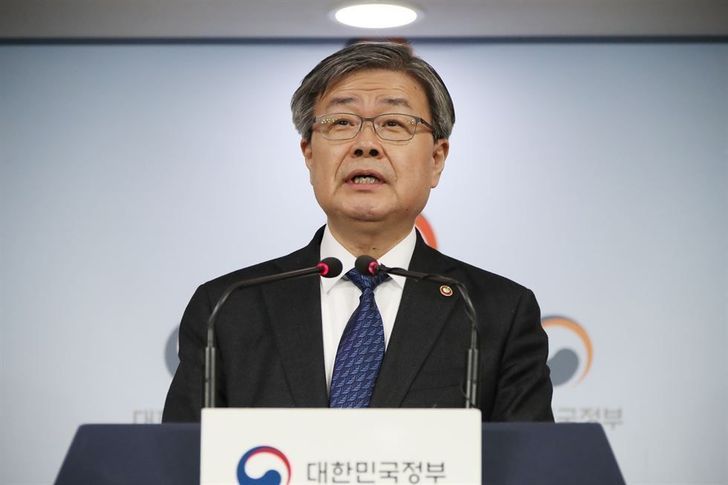
Employment and Labor Minister Lee Jae-kap announces a draft to change the decision-making process for minimum wage increases, at the Government Complex Seoul, Monday. / Yonhap
By Kim Hyun-bin
By Kim Hyun-bin
The government will revise the Minimum Wage Commission to divide it into two sub-bodies, with one setting the range of a proper minimum wage hike and the other deciding the increase rate within the range.
The government believes the restructuring will help reduce the gap for hopeful wage increases between labor and management. But the labor sector claims the change will deprive the labor and management sides of autonomy.
Labor Minister Lee Jae-kap announced the draft of the commission's restructuring, which the government believes will bring fairness and objectivity in deciding the wage level.
“This marks the first change in the commission's decision structure since 1988,” Lee said. “We took reference of the International Labor Organization's (ILO) minimum wage resolutions, as well as other countries' policies to enhance our restructuring.”
The change has come amid claims from businesses that sharp increases of the minimum wage for the last two years under the Moon Jae-in administration have caused heavy burdens on small business owners and layoffs of part-timers. Also the minimum wage has often become a political issue, with Moon promising to raise it to 10,000 won ($8.80) per hour during his presidential election campaign but later scrapping it.
The current commission is comprised of 27 members, with nine each from labor, management and the public sector, with the public sector representatives consisting of professors and researchers.
Under the draft, the commission's role will be divided into two sub-bodies, a committee setting the wage hike range and another deciding the rate.
The wage range committee will consist of nine experts including professors and researchers, who will provide a suitable wage hike range for the following year's minimum wage. The ministry says the range committee will be more objective and fair as the members are not involved in unions or management.
Once decided, the decision committee will set the following year's minimum wage within the provided range. Its members will be five or seven each from labor, management and the public sector. They will also include not only umbrella union leaders and large business lobby groups but also other minority representatives including young people, women, irregular workers and small businesses.
The country's two umbrella labor unions ― the Korean Confederation of Trade Unions (KCTU) and the Federation of Korea Trade Unions (FKTU) ― voiced opposition to the government's new proposal, claiming their negotiation position will weaken due to the addition of more groups in the decision-making process.
“The experts setting the range of the minimum wage infringes on the autonomy of the unions and management. We will have no choice but to set the minimum wage from the given range,” the FKTU said in a statement.
The two labor groups are scheduled to hold a workshop with the labor representatives on the Minimum Wage Commission to better counter the government's proposal.
The government aims to finalize the draft by the end of this month, so the new structure can be applied in the decision-making process for next year's minimum wage which should be decided by July.
The ruling Democratic Party of Korea (DPK) floor leader Hong Young-pyo said the National Assembly will do all they can to implement the restructuring before July.