INTERVIEW 'Car-free street can revive Sinchon'
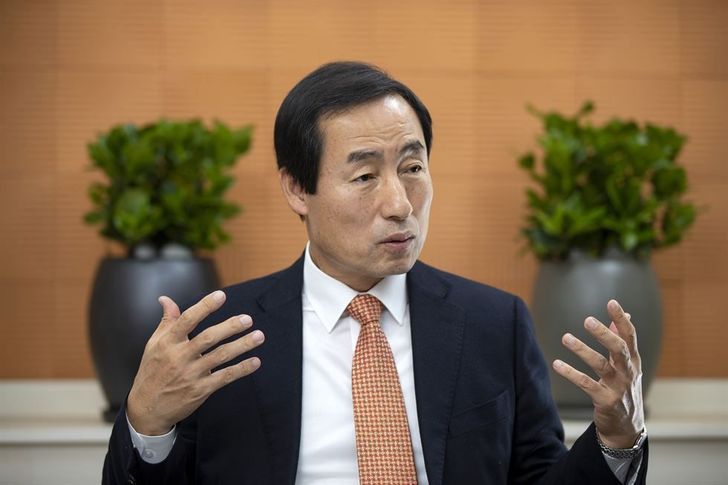
Mun Seok-jin, head of Seodaemun-gu Office, talks about his plans for his district in an interview with The Korea Times at his office, Nov. 19. / Korea Times photo by Shim Hyun-chul
An interview with the head of Seodamun-gu Office
By Lee Suh-yoon, Kang Seung-woo
Mun Seok-jin, 63, a third-term district head of Seodaemun-gu in northwestern Seoul, has a clear goal for his remaining three and a half years in office: revive the once-bustling neighborhood of Sinchon.
“The neighborhood declined due to gentrification 15 years ago, but with the car-free road in front of Yonsei University, it is recovering slowly,” Mun said at an interview in his office on Nov. 19. “Unlike Hongdae's clubbing culture, Sinchon now has its own plaza vibe, which is very youthful and dynamic. The number of visitors has jumped thanks to Yonsei-ro.”
Yonsei-ro is a 500-meter-long street connecting Sinchon Station on Seoul Metro Line 2 with the main gate of Yonsei University. In 2012, Seodaemun-gu Office and Seoul Metropolitan Government closed it off from private vehicles on the weekends, creating an open pedestrian space and a venue for festivals and music performances. The street is now blocked off for pedestrians only from 2 p.m. every Friday to 10 p.m. the following Sunday.
“The idea for a car-free Yonsei-ro came when I visited Brazil's Curitiba, or flower street, with Seoul Mayor Park Won-soon,” Mun said. “We decided to try it to create a pedestrian plaza that could host various events and attract people to Sinchon.”
Sinchon, the commercial area in front of Yonsei and Ewha Womans University, is a glaring example of how gentrification can bleed a neighborhood's identity dry, and drain its appeal for visitors. Skyrocketing rent chased out small businesses that had created the area's identity, replacing them with franchises and big brands that one can access anywhere else in Seoul.
Mun wants to expand the car-free service to weekdays, fixing the area as the “open-air event hub” of Seoul.
People enjoy the annual Sinchon Water Gun Festival in July. / Courtesy of Seodaemun-gu Office
“Our cherry blossom event in the spring did not really catch on but we have established annual events for every other season: Water Gun Festival in the summer, Craft Beer Festival for fall, and the Christmas Festival for winter,” he said with a grin. “We often get approached by foreign embassies. Last year, we held a joint fashion show with Iran, showcasing both hanbok and traditional clothes from Iran.”
Foreign exchange students are some of the most avid participants of these annual events, Mun says.
“We get a surprising number of foreign students at our events. I think they share information about these events through their own networks,” Mun said. “A lot of exchange students prefer to live in Sinchon even if they are not attending Yonsei or Ewha Womans University, but another one far from here.”
Historical tour belt
Mun plans to develop a historical tour belt that starts at Independence Gate, passes Seodaemun Prison Hall and reaches a memorial hall, due to be built by 2020, honoring the provisional government of Korea formed during the 1910-45 Japanese occupation.
“I hope the course provides insight into how Korea was able to go from one of the poorest war-stricken nations to the 10th-biggest economy in the world ― not in terms of industrialization and modernization but by showing how it struggled for its independence and democracy,” Mun said.