University adds social value with upcycling project
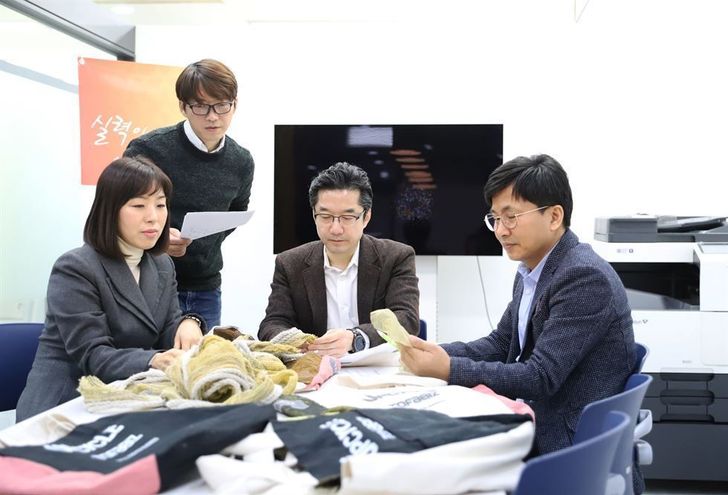
Professors at Hanyang Women's University (HYWU) and officials from Leaders in INdustry-University Cooperation (LINC+) meet to discuss sustainable design, Thursday. From left are professor Kang Hee-myung of the knit fashion design department, professor Kang Dong-seon of the industrial design department, director Lee Ho-sung of HYWU's Office of Industry-Academy Cooperation Foundation, and director Kim Hong-gyu of the LINC+ Urgent Response Center for Industry. Courtesy of Kang Hee-myung
By Jung Hae-myoung
Hanyang Women's University (HYWU) is promoting a project to produce socioeconomic value through fashionable “upcycled” bags that could ease environmental and employment problems.
The project, led by the school's Leaders in INdustry-University Cooperation (LINC+) organization, is to make bags from recycled fishing nets and waste collected from Nagwol Island in South Jeolla Province. The nets are recycled, dyed and used as fabric to make tote bags.
The school participated in the Industry-University Exposition held at BEXCO in Busan from Nov. 7 to 9 with the bags.
“Upcycling has been an issue in Korea since 1990, but the prices of upcycled products were too high and the designs were not so appealing to consumers,” said Kang Hee-myung, professor of the school's knit fashion design department who participated in the project.
“For this exposition, we submitted bags whose price and design can meet an individual's preference and the values of society,” she said.
Kang said there were some problems during the process. “There was a limited number of fishing nets we could transport from the island by boat, but we made contact with two transportation companies to make it easier,” she said.
Although the project is led by the school, it invites Seoul senior citizens who live alone to join the production process to support their livelihoods. Kang said they wanted to create a social model for making a virtuous cycle, and not just remain a “school project.”
“Of course social value is important, but we wanted to make a bag that people want to buy regardless of recognizing they are contributing to social value,” Kang said. She hopes creating social value can become a model for the fashion industry.