Kang Seung-woo is the Business Desk editor at The Korea Times. Prior to this position, he covered politics, national affairs, finance and sports.
'I look forward to seeing end of dog farms'
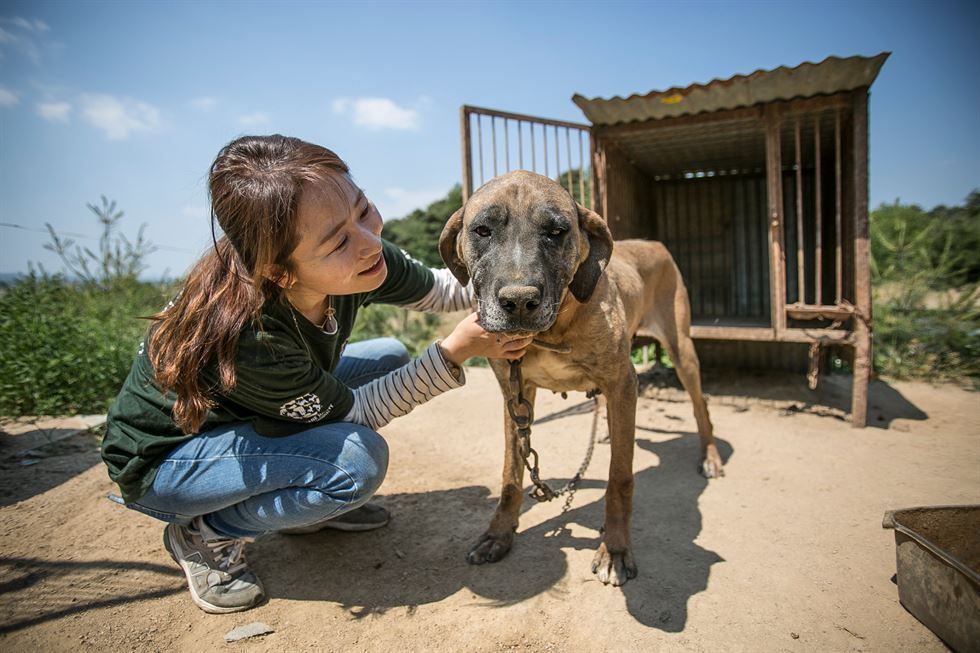
Humane Society International (HIS) campaign manager Kim Na-ra poses with a Tosa dog at a dog farm in Korea. / Courtesy of HSI
By Kang Seung-woo
This is the first in a two-part series on the nation's dog meat culture and people involved in it. -- ED.
HSI manager believes dog meat debate entering final phase
By Kang Seung-woo
Max, a Tosa dog rescued from a dog meat facility in Namyangju, just east of Seoul, ahead of last year's “boknal,” or “dog days,” may have lived its entire life with its legs bowed, if not slaughtered for human consumption.
The Japanese-originated breed is most commonly used here for “bosintang,” or dog meat stew, due to its massive size.
Instead, the dog, which underwent a series of surgeries to straighten its deformed legs, is now living the same life as other well-loved pets in Canada.
“A large number of canines on dog farms have bowlegs because they are confined in elevated wire cages with no room to roam for their entire life before being brutally killed, cooked and eaten,” Kim Na-ra, a campaign manager of the Humane Society International (HSI) Korea, told The Korea Times.
According to Kim, Korea is the only country that allows intensive farming of dogs for human consumption. There are 17,000 dog farms across the country, with an estimated 2.5 million dogs raised for food.
“Max's new owner recently sent me some pictures of the dog swimming for the first time, adding the owner is really happy that it is well on its way to becoming a normal pet,” Kim said.
“As many acts of cruelty are perpetrated against dogs on dog farms, I hope other dogs crammed in tiny cages will be as happy as Max through our campaign.”
HSI is the international division of the Humane Society of the United States based in Washington, D.C. and it works in more than 40 countries to support animal welfare legislation and fight animal cruelty.
In Korea, the organization has made its mark thanks to its campaign to shut down dog farms nationwide since 2015 after finding many dogs, locked in crammed cages, lived in horrid conditions.
Since then, the animal welfare organization has closed 12 farms and rescued 1,400 canines, almost all of which were adopted overseas, including to the United States, Britain and Canada.
Entering this year _ especially around the PyeongChang Winter Olympics in February _ the issue of banning the human consumption of dog meat has risen to the fore in Korea, pitting the HSI and other animal rights groups against dog farm owners, who are protesting to protect their livelihoods.
The farmers' argument is: “If pigs, cows and chickens are all raised for their meat, why not dogs?”
Kim admitted it was also the biggest dilemma she faced in the past.
“At the time, I also ate meat, so I agreed with their assertion before joining the HSI. Even after starting to work for this organization, I still struggled to find a clear-cut answer,” she said. Now, Kim no longer eats meat.
However, U.S. Olympic skier Gus Kenworthy finally gave her the long-awaited answer.
“Earlier this year, when we were working to close the 12th facility, he joined our rescue and said that even though there were 10 problems we faced, we cannot leave all of them unsettled,” Kim said.
“He advised that we try our best to solve even one problem.”
After the rescue, Kenworthy also adopted a puppy from the farm.
She added: “We cannot urge all people to live on vegetables, but we need to come out to end the animal abuse committed on dog farms. That is significant.”
When the HSI and owners of dog farms agree to permanently close the facility, the body financially helps them to transition to more humane work.
The HSI is now working to close the 13th farm in Namyangju, which is expected to be completed within this year.
“After seeing our campaigns, more owners themselves or their family members are expressing an interest in getting out,” she said.
HSI campaign manager Kim Na-ra, left, and another staffer rescue a dog from a dog meat facility. / Courtesy of HSI
Paying off
On the back of efforts by the HSI and other animal rights groups, and with younger generations increasingly refusing to eat dog meat, the campaign to phase out the trade in Korea is paying dividends, according to Kim.
“Compared with two years ago when I joined HSI Korea, the current situation is in favor of our campaign,” said the manager, who previously worked as a researcher at the state-run Animal and Plant Quarantine Agency.
“In that respect, I think the campaign is entering its final stretch.”
She added that Tori, President Moon Jae-in's adopted dog rescued from a dog farm, is also creating positive vibes for their campaign.
“The fact that the head of state is fond of dogs and interested in animal issues itself is encouraging,” Kim said.
In August, Cheong Wa Dae said it may consider revising the law on domestic animals to remove dogs from the list of livestock _ a move that may pave the way for ending the dog meat trade for good.
On such a winning vibe, Kim hopes that rescued dogs will find new owners in Korea.
“It is a pity to see dogs once raised and loved as pets are crammed into wire cages and sent overseas to find happiness,” she said, adding that only three among 1,400 rescued dogs have been adopted locally _ one by former British Ambassador to Korea Charles Hay, an HSI volunteer and Kim herself.
“Finding new homes for those dogs in Korea is the most ideal, but it is practically a tall order as people here are unwilling to adopt them simply because they are from dog farms.
“I hope Koreans' perception of dogs rescued from such facilities will improve.”