Environmentalist dreams of DMZ Peace Zone
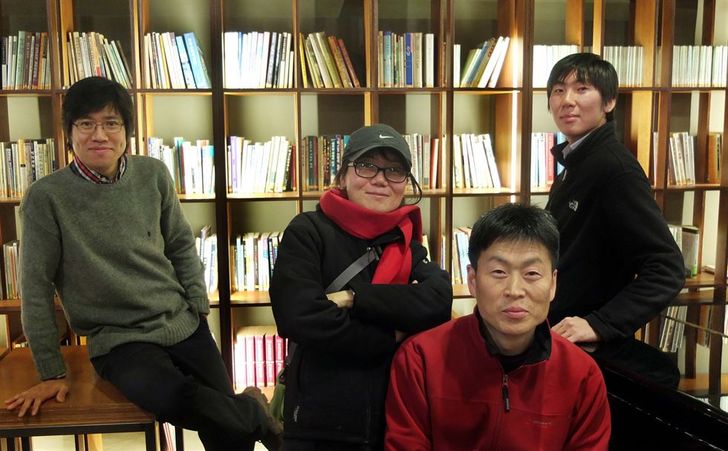
Seo Jae-chul, second from right, with the Green Korea United workers / Courtesy of Green Korea United
By Park Ji-won
Amid the fast changing political landscape on the Korean Peninsula, an environmental activist has become one of most cited persons in the media and at seminars when it comes to talking about the Demilitarized Zone (DMZ).
“I am spending of the busiest days of my life participating in seminars to talk about the DMZ recently,” Seo Jae-chul, a senior ecological activist with Green Korea United with about 20 years of experience, told The Korea Times at the National Assembly, Tuesday.
He was visiting the legislature to take part in a seminar on preserving species of wild animals.
As one of the civilians who has visited the DMZ more than 200 times from the end of 1990s up to the present, and the only person who has walked along the DMZ from end to end, he has become one of the most summoned experts when talking about unification and peace.
Since April 27 when leaders of two Koreas signed the Panmunjeom Declaration which seeks to end the war on the Korean Peninsula, a peace agenda has been attracting public attention, getting people to be involved in discussions to come up with measures to implement the agreement.
Under the changing atmosphere, Seo has been stressing the preservation of the DMZ as a symbol of peace for many years.
“The DMZ symbolizes the result of the Cold War and separation. It is one of the most curious places in the world.”
Civilians have been restricted from entering the 250-kilometer border barrier that divides the Korean Peninsula, according to the armistice between the two Koreas. In order to visit the DMZ, an individual must obtain permission from the government.
One of the executives of the 27-year-old Green Korea United since Seo joined it in 1996, he has been focusing on the environmental protection of mountains, the DMZ and species of wild animals; and providing the government with results of environment assessments and proposals to improve it.
He emphasized the importance of the DMZ's environmental and historical value as it has been sealed off from the rest of the country for many years, without people's intervention.
“If people touch nature, it is destroyed. The DMZ's creatures don't avoid people as they haven't been exposed to them. The zone is a rare place where nature restores itself.”
He highlighted the rarity of the DMZ's existence. There was a similar restricted demilitarized zone, the “Grunes Band” in Germany, but he noted that “it didn't experience a killing war between the same people as we did for three years during the Korean War which broke out in 1950.”
Seo added that's why it is meaningful to designate the area, not only because it is a secret place but also because it holds many undiscovered stories of the Korean War.
“I wonder what happened in the land from the past war to the present; what the U.S. and the two Koreas did there.”
When asked about the government's role, he said that it must make it a tourist site under the condition of preserving the area as it is.
“When you think about tourism, people construct buildings first. It is a waste of taxes and devalues the DMZ. The Gyeonggi provincial government should help the local people participate in tourism. Also, the tourists should be responsible in the area.”
He is now paying attention to how climate change, with the deadly hot weather this summer, has affected the DMZ.
“People never experienced this kind of hot weather. But there was an omen in the past. Needle leaf trees are dying in the national park in the South. It is the beginning of the effects of climate change. But, there is no countermeasures for them. We just keep recording the changes.”