Universities rushing to buy buildings
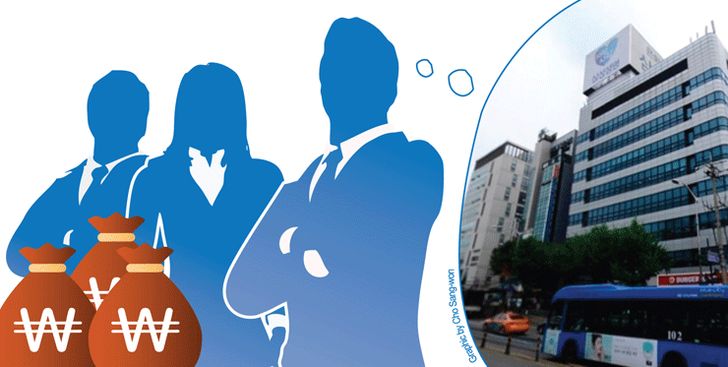
Illustration by Cho Sang-won
By Lee Kyung-min
Universities are rushing to purchase office buildings in Seoul using the money from their foundations to earn rent to pay salaries and other operational costs.
The schools are supposed to use the funds, raised from graduates and other contributors, to finance research and other educational programs. But they are increasingly opting to buy commercial buildings to generate larger income amid low interest rates and the booming property market.
The Dongwon Education Foundation, which owns Hankuk University of Foreign Studies (HUFS), bought a 10-story 7,454.71-square-meter building in northern Seoul from Samsung Life Insurance for about 19 billion won ($17 million) last month.
“We bought the building to rent out,” an official from the foundation said. “It is a great way to secure foundation revenue as we can expect monthly payments from the tenants on a regular basis with the knowledge we have secured after running a similar business using a building in Daechi, southern Seoul.”
The foundation has yet to finalize the list of tenants, but it will use the money to pay about 5 billion won to support the foundation-run educational institutions including HUFS and Cyber HUFS and pay premiums to state-run insurance programs.
Similarly, Hansung Educational Foundation which owns Hansung University, Hansung Girls’ High School and Hansung Girls’ Middle School in Seoul, bought a 17-story 8,476.78-square meter building for 24.2 billion won. Current tenants at the newly named “Hansung Building” include a convenience store, banks and credit card companies.
“We bought the building to diversify our revenue portfolio,” an official from the foundation said. “We have relied solely on deposit interest, but as the interest rate has plummeted to around 1 percent from 5 percent five years ago, we were left with no option but to seek other measures."
Sixty percent of the foundation’s revenue comes from building rent, with the remaining 40 percent from deposit interest. However, the management may seek more revenue by purchasing another building.
“As the deposit interest rate shows no signs of increasing for the time being, the management may consider purchasing a building for rent-collecting purposes,” she said.
The foundation said it plans to provide about 760 million won to the three schools to cover the state-run insurance program premium.
“The estimated yearly rent is about 12 billion won. We will send the money to the three schools soon.”
Yonsei University owns a 24-story 108,806-square-meter building and 13-story 20,741-square-meter building near Seoul Station.
An official from the Konkuk University Foundation, which led the “Star City Project” through which a residential and commercial complex was set up near the school in Eastern Seoul about a decade ago, said continued investment in the area helps the school secure long-term revenue.
“We opened the complex in 2007 to utilize revenue made there to invest back into education. We could hire more professors and reconstruct old buildings to maximize our students’ convenience like we did a few years ago,” he said.
The foundation sees 8 billion won in revenue by operating the complex, some of which is used to pay premiums for state-run insurance programs and to increase student welfare.
“Many older schools are reluctant to remodel classrooms, but we did much work to improve the studying and working environment for students and faculty.”