Seoul's fine dust lead, calcium levels now available online
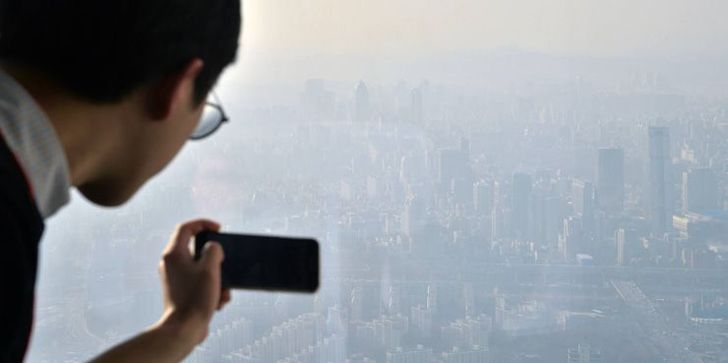
A visitor to Lotte World Tower's observatory in Jamsil-gu, Seoul, checks foggy air contaminated with fine dust in January 2017. / Korea Times file
By Ko Dong-hwan
Residents can monitor Seoul’s air quality more closely after lead and calcium levels in fine dust clouds were made available online from Thursday.
The National Institute of Environmental Research (NIER) is showing on Air Korea, a Korea Environment Corporation website, how much the skies above Seoul and North and South Gyeongsang provinces are contaminated with the chemicals. Seoul’s monitoring is done from the city’s Eunpyeong-gu and the provinces from Ulsan’s Jung-gu in South Gyeongsang Province.
The update follows the launch of the service at Baengnyeongdo Island ― the nation’s northwestern endpoint close to the inter-Korean border ― Gyeonggi Province and South and North Chungcheong provinces in 2015, and Jeju Island and South and North Jeolla provinces the following year.
The figures in nanograms per cubic meter are updated every two hours, showing an average figure in units of two hours, 24 hours and one year.
“The readings will be used to find the causes of air pollution above particular regions across the country and evaluate the hazardous level of the chemicals on humans,” a NIER official said.
Lead can accumulate in the blood, bones and cells, affecting the nervous system. It also can cause seizures and cognitive disorders. The World Health Organization defines 500 nanograms per cubic meter as lead’s maximum standard for air safety.
Calcium, although not harmful to health, can indicate other air contamination.