Applying advanced tech to education
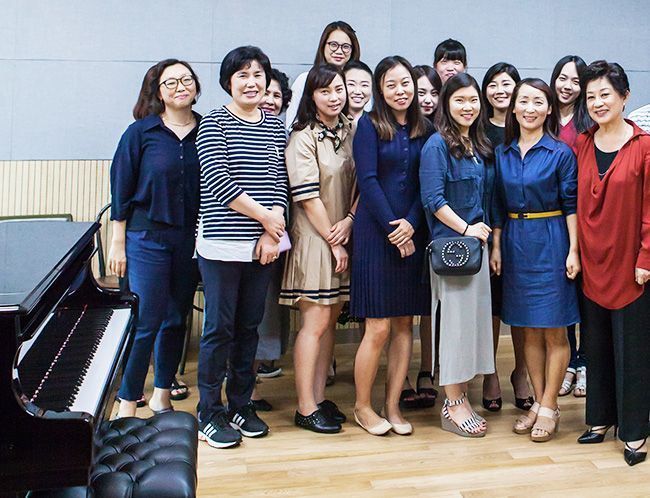
Lee Kyung-sook, right, chair professor at the music department of Seoul Cyber University, poses with students majoring in piano in a practice room on the school’s campus in Seoul. The university launched the music major in March, using distance-learning technology. / Courtesy of Seoul Cyber University
Seoul Cyber University aims to become leader in e-learning
By Chung Hyun-chae
Seoul Cyber University President Huh Myo-yeon
Seoul Cyber University (SCU) is doubling down on its efforts to capitalize on the latest information and communication technologies (ICT) to keep its position as the nation’s top e-learning institution.
“We opened a music major in the culture and arts department in March, the first of its kind in Korea using distance-learning technology,” said SCU President Huh Myo-yeon.
The university bought three Yamaha Disklavier acoustic pianos outfitted with electronic sensors for recording, and electromechanical solenoids for playback.
Sensors record the movements of the keys, hammers and pedals during a performance, and the system transfers the performance data to a music file.
Receiving the file, the original performance can be reproduced on another piano ― even in a different country ― with the exact same tones of the original and the same amount of pressure that the player’s fingers applied to the keys.
“We signed a memorandum of understanding with the Moscow Conservatory, one of the top music universities in the world, earlier this year, to provide our students with high-quality lessons from some of the best teachers in the world,” Huh said.
“Unless it is a cyber class, students in Korea cannot find opportunities to have lessons with the Moscow Conservatory.”
Seoul Cyber University President Huh Myo-yeon, left, demonstrates how to record lectures for students to Kim Su-sie, right, former president of the university, and an official from the Ministry of Education of the Republic of Malawi on the school's campus in Seoul in October. Kim invited the Malawi official to show him how the cyber university runs. /Courtesy of Seoul Cyber University
If a student plays the piano in a practice room on the school’s campus in Gangbuk-gu, northern Seoul, a professor in Russia can listen to the student’s performance in real time.
“We plan to form relationships with more foreign music schools in other countries,” said Ra Jung-hye, piano professor at Seoul Cyber University, adding that the technology will revolutionize music education.
“I hope the technology will bring more innovations to education, especially for music.”
Students can take one-on-one lessons, mostly on Saturdays. On weekdays, they study music theory, including harmonics and music history. They also receive practical training by webcam.
“I hope our university will promote piano education further, which has long been too expensive for those wanting to take lessons,” Huh said.
The tuition at Cyber University is about one-third that of other music schools in Korea, which Huh believes could expand opportunities for more students.
Currently, 30 students are taking piano courses at SCU. They come from all walks of life ― housewives, truck drivers and piano academy instructors.
Amid an extraordinary classical music boom that started with Cho Seong-jin’s win at the 17th International Fryderyk Chopin Piano Competition in October, an increasing number of people have been showing keen interest in the piano program.
The university launched an online piano competition in November. It said about 100 high school students and adults applied for the competition before the Dec. 7 deadline by uploading their performances on the school’s homepage.
On Dec. 29, it will announce the winners, who will receive prize money as well as scholarships for the piano major.
“I am dreaming of creating more physical education and art classes such as ballet with more advanced technologies in the future,” Huh said.
Frontier technology
The university beats other cyber universities not only in advanced technologies in music programs but also in its outstanding e-learning methods.
SCU’s Learning WAVE e-learning system won a silver prize at the IMS Learning Impact Award in 2011 ― an international awards program designed to recognize the most effective uses of ICT worldwide in support of learning.
The best feature of the university’s self-developed system is that professors can update their lectures and post the changes on the website.
The system also allows students to attend lectures through their smartphones, as well as through their computers.
In addition, professors and students can communicate through social networking services (SNS) including Facebook and Twitter.
In recognition of its advanced e-learning system, the university was selected by the Ministry of Education to participate in the ASEAN Cyber University Project in 2012.
Since then, the school has spread its e-learning educational knowhow to ASEAN partners.
SCU also offers lectures to university students in ASEAN countries with English and local language subtitles.
“We plan to provide the universities with our Learning Management System, a simpler version of the SCU Learning WAVE, next year,” Huh said.
SCU has 12,353 undergraduate students and 353 graduate students. It offers 20 majors, the most popular of which are social welfare, psychology and the counseling departments, with about 60 percent of the total students enrolled in classes taught in these departments.