Daejeon to cultivate global citizen with creativity
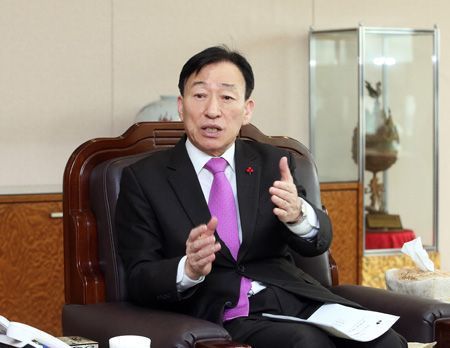
Sul Dong-ho, superintendent of the Daejeon Metropolitan Office of Education, speaks during an interview with The Korea Times on Dec. 23. / Courtesy of Daejeon Metropolitan Office of Education
Top educator will recruit more native English teachers
By Chung Hyun-chae
Daejeon’s top educator says he will take the lead in fostering global citizens with creativity and innovative ideas.
“It is necessary for students to have creative thinking to compete with talented people internationally in an increasingly globalized world,” Sul Dong-ho, superintendent of the Daejeon Metropolitan City Education Office, said.
In a recent interview with The Korea Times, Sul disclosed his New Year policy goal of cultivating students into citizens of the world. He has vowed to make this goal one of his top priorities in 2015.
Creative education for creative talent
The education chief is convinced that it is necessary for students to become creative in order to grow into globally talented citizens.
“A creative person is strong in coping with a crisis, an ability needed to survive in an information and knowledge-based society. We have so many different kinds of problems, for example relationships, which require intuition and insight,” he said.
“Let’s look at a company that goes bankrupt. In this situation, only a creative employee can survive and rebound by analyzing the company’s faults while less-creative people just blame others for their misfortune,” he added.
To cultivate this kind of talent, he stressed three things: acquiring knowledge in the classroom, reading books and engaging in experiential activities.
“Recently we decided to lessen school teachers’ workload by 20 percent in order for them to spend more time on guiding children to read books and study more,” he said.
Among three factors, Sul values the reading class the most.
“I think students should participate in a book discussion class. They could perform plays and act as main characters in front of the class during the book discussion. I believe a series of activities increase students’ creativity,” he said.
He also called for professional librarians in schools.
“When teachers teach class on a certain subject, librarians could recommend relevant books which help students have a better understanding,” he said.
The education office also plans to reform libraries in the city.
Sul said Daejeon has the advantage of having many science and research institutions in the Daedeok Science Town. The city embarked on an International Science Business Belt project this year.
“I’m planning to utilize such an environment in activity projects,” he said.
Practical English education
Sul, who earned a Ph.D. in English language and literature from Chungnam National University in 1987,
has
emphasized practical English education.
In order for students to improve their practical English skills, he believes that there should be more native English teachers who can teach real English.
“I would like to increase the number of native English teachers in schools as long as the education office can tap the financial resources to do so,” he said.
According to the superintendent, this is not only for English speaking but also for English writing skills.
“To communicate with foreigners on a daily basis, one needs to speak English well, as well as write letters and draw up papers. The point is that the students should receive comprehensive education so that they can interact with foreigners,” he said.
“And only native English speakers can teach children accurate English pronunciation and intonation, which makes for better communication,” he added.
His policy is not in line with other education offices nationwide that are trying to reduce the number of English-speaking teachers due to financial constraints amid a plan by the central government to cut its financial support to local authorities.
Given these circumstances, the Daejeon office can hardly increase the number of native teachers right now, but Sul promised to prioritize it during his term.
Despite his focus on practical English learning, Sul said he would accept a plan by the Ministry of Education to adopt an absolute evaluation system for English scores in the College Scholastic Ability Test (CSAT) in 2017, scrapping the current relative grading system.
“What’s more important is to make the students master English at an easy level, not to evaluate them with difficult vocabulary in order to rank them by scores,” he said.
Sul’s other English education policy option is to expand academic and culture exchanges with overseas schools.
“As far as I know, some overseas universities have a variety of home-stay programs, in which they connect foreign students of all ages to local families,” he said.
He believes that language education starts from learning another country’s culture.
His education office has already been operating three exchange programs with a number of nations including the U.S., Britain and Australia.
On the subject of environment and culture, four elementary schools and three middle schools in the city have been working on joint projects through websites with schools in Britain, India, Taiwan and South Africa since 2009. This exchange program is called “Connecting Classrooms” supported by the British Council Korea.
Another one is a “Video Conferencing” program which started in 2012. Under this program, elementary and middle school students in the city can take lectures about culture provided by the University of New England in Australia.
The last is a sort of mixture of the two programs above. Under the program, five high schools exchange lectures via video and have joint projects on various subjects with American schools. The schools embarked on the program last year.
“I expect our students will have a better understanding of cultural diversity and develop a global mindset through these exchange programs,” he said.
Connected education from kindergarten to college
Sul is also pushing for an ambitious project of establishing
“Connected Education from Kindergarten to College,” the first of its kind in Korea.
It connects the curriculum of kindergartens to that of elementary, middle and high schools and further to that of colleges and universities to improve the continuity of education throughout one’s adolescence.
The project is divided into three parts: linking kindergartens and elementary schools, linking middle schools to high schools and linking high schools to colleges.
“Recognizing the importance of career education as well as a creative education, I’ve designed this project,” he said. “It is crucial to find one’s talent and aptitude from an early age so that they can focus on what they want to do in the future without wasting time during their teens.”
Although the project is still in development, the office announced some details of linking kindergartens and elementary schools.
“In order for preschool children to adapt themselves to a new environment, elementary schools will run more plays, and experience activities during class time instead of academic programs,” he said.
Also, the office plans to prepare a model class for teachers of elementary school first graders to understand the transitional model.
“I’m also planning to link high schools to college programs, under which high school students could take lectures from colleges and experience actual laboratory activities at college laboratories during vacations. Students can decide which college to enter or to start a whole different thing after graduation by doing so,” he said.
Sul believes that the project will contribute to national development by raising the right people in the right places.