HK looks up to Korea's education
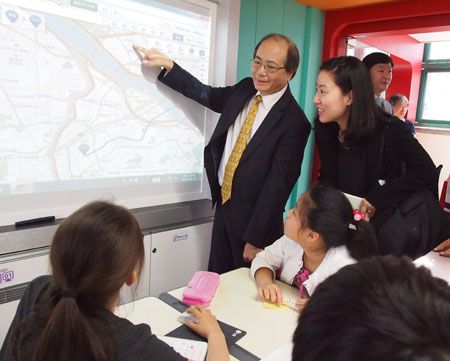
Eddie Ng, secretary for education of Hong Kong, learns how to use information and communications technology during a class at Itaewon Elementary School, Seoul, May 31. / Courtesy of Hong Kong Education Bureau
Secretary Ng seeks cooperation in kindergarten, IT application
By Bahk Eun-ji
Hong Kong’s chief education policymaker said Korea is a role model for kindergarten education and application of IT in teaching and learning.
“Korea has been very successful and very determined in terms of education system performance around the world,” Eddie Ng, secretary for education of Hong Kong, told The Korea Times during his visit to the country last week.
“We are in the middle of e-learning and e-text book projects, and in particular, discussing about smart education and digital education. We have a lot of things to catch up on, exchange and learn from each other during this visit to Korea,” he said.
The secretary pointed out that Hong Kong and Korea face similar issues regarding kindergarten education and have implemented similar efforts to address them.
Ng visited Seoul from May 29 to June 1 to strengthen Hong Kong’s cooperation with Korea in the field of education.
On the first day of his visit, Ng went to the Samsung Electronics headquarters to observe the latest development of IT applications for daily life in Korea, including in an education showroom showcasing technology for interactive teaching and learning in classrooms.
“We have implemented three IT applications in education strategies and invested more than 9 billion Hong Kong dollars for the implementation of a wide range of policy initiatives since 1998,” Ng said.
He also pointed out that now, all schools in Hong Kong already have the necessary IT infrastructure and facilities, as wells as teachers with enhanced know-how and ability to adopt digital learning resources and develop IT pedagogy.
“We will continue with the Pilot Scheme on e-Learning and the e-Textbook Market Development Scheme launched in 2010 and 2012, respectively. The first batch of e-textbooks will be rolled out in 2014,” he added.
He also visited the Seoul Early Childhood Education and Development Institute, an affiliate of the Seoul Metropolitan Office of Education (SMOE), which supports young children by providing educational programs and services.
In addition to touring the SMOE facilities, he was briefed on the local kindergarten education system and training and support services for teachers.
He then met with Na Seung-il, Korea’s vice education minister, to exchange views on the development of free kindergarten education and IT in education.
He noted that Korea has faced challenges in kindergarten education similar to those in Hong Kong, such as funding arrangements, parents’ expectations, teacher training and qualification, education quality and subsidies.
He noted that the introduction of free kindergarten education is not an easy task but a complex issue involving different stakeholders.
“To pave the way for practical free kindergarten education in Hong Kong, the Education Bureau has set up a committee with members from the kindergarten education sector, academics, professionals and parents to prudently look into the issue and conduct relevant studies,” he said.
“It is expected that the committee will complete its task and make evidence-based recommendations to the government within two years,” he added.
Ng believes his visit to Korea would help in the planning and development of free kindergarten education and IT in education in Hong Kong. He sees great potential in bilateral education collaboration between Korea and Hong Kong.
“First, both of us have a sound education system as Korea and Hong Kong ranked second and third in the list of 40 countries with the best education systems in an international research report published by Pearson in 2012,” he said.
“Second, Hong Kong and Korea are making efforts toward an increasingly subsidized and free kindergarten education as well as promoting IT in education. Thus, we are facing both the opportunities and challenges arising from the policy initiatives,” he said.
Therefore, he said, Hong Kong and Korea have a common ground on which they can exchange views and information to enhance education and students’ learning outcomes.
“I’m happy to learn about the unified program of kindergarten education and bring it back to Hong Kong to put in practice,” he said.
He referred to the “Nuri Program,” implemented by the Ministry of Education in Korea to help children aged three to five to get a decent quality of education.