Why Korea's president is talking about sanitary pad prices
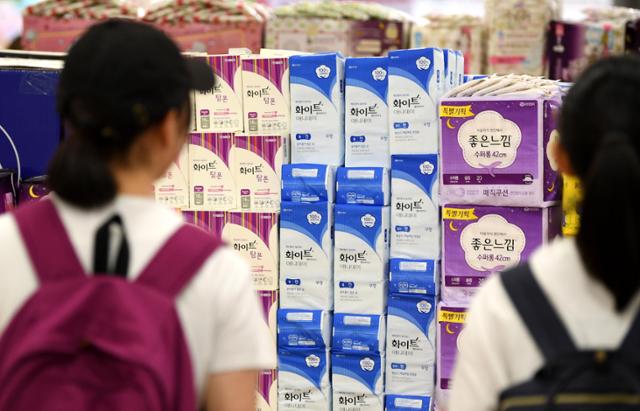
A woman browses sanitary pad products at a large supermarket in Seoul. Korea Times photo by Hong In-gi
“State-produced sanitary pads” have emerged as a topic of discussion in Korean politics after President Lee Jae Myung repeatedly criticized the high price of menstrual products and ordered officials to explore policies to provide them free of charge.
As the government reviews the feasibility of such a plan, some observers have already begun referring to it as a “basic sanitary pad” policy — a nod to Lee’s earlier push for “basic income” during his time as a local government head.
Women’s groups, however, caution that affordability cannot come at the expense of safety.
According to government officials on Sunday, the Ministry of Gender Equality and Family recently held an internal meeting to discuss policy responses to the high price of sanitary pads.
Alongside existing options such as in-kind distribution and voucher support, the ministry is also considering a contract-manufacturing model proposed by Lee.
Under this approach, the government would commission the production of sanitary pads that meet a baseline quality standard and distribute them free of charge to designated groups.
Korean President Lee Jae Myung speaks during a Cabinet meeting at Cheong Wa Dae in Seoul, Jan. 20. Korea Times photo by Wang Tae-suk
Lee calls for free pads meeting baseline quality standards
The issue was first raised in last month, when Lee asked officials to investigate why sanitary pads in Korea are more expensive than those sold overseas during a policy briefing with the Fair Trade Commission (FTC) and the gender ministry.
Data supports the concern. A monitoring report by the Korean Women’s Environmental Network in May 2023 found that domestic sanitary pad prices were about 39 percent higher than those in foreign markets.
But Lee has argued that cash-based subsidies alone are ineffective in reining in market prices.
“Government handing out subsidies would only help companies ripping off consumers,” said the president said at a Cabinet meeting last month.
“We should consider whether the state can produce low-cost pads with basic quality standards and provide them free of charge to certain recipients.”
Concern that price is prioritized over safety
The Korean Women’s Environmental Network, while welcoming the administration’s willingness to address the issue, said that safety concerns have also been a major driver of rising prices.
“Sanitary pad pricing has been shaped not only by higher raw material costs but also by marketing strategies built around safety anxieties,” the organization said. “Many consumers, seeking to reduce potential health risks, have turned to organic or eco-friendly ‘premium’ products perceived as safer, ultimately paying more.”
The activist group emphasized that the government should focus on producing sanitary pads that are both affordable and demonstrably safe, rather than merely cheap.
Critics who emphasize market principles warn that without first addressing structural price distortions, introducing free sanitary pads could backfire.
Offering free pads before examining factors such as distribution margins, import regulations and certification and labeling systems puts policy steps out of order, according to Center for Free Enterprise.
“Once the state sets official standards for price and quality, consumers risk becoming passive recipients constrained by those benchmarks.”
The Korean Women’s Environmental Network also called for thorough market investigation to find cause for higher prices, urging the FTC to conduct a comprehensive probe into sanitary pad pricing and to disclose its findings publicly.
“Broader research into women’s actual usage experiences, financial burdens during purchase and constraints on choice all need to be looked at,” the group said.
It also pressed for stronger safety oversight, including exposure and toxicity assessments for menstrual products, and for building a system in which production, management and distribution operate under clear state responsibility.
This article from the Hankook Ilbo, the sister publication of The Korea Times, is translated by a generative AI system and edited by The Korea Times.