Lee Hae-rin is a City Desk reporter at The Korea Times, covering social issues, tourism and taekwondo. She is passionate about speaking up for the rights of minorities, including women, LGBTQ+, people with disabilities and animals as well as discovering the latest makgeolli trend in town. Feel free to reach her at lhr@koreatimes.co.kr.
Protesters wrestling with alternative collective action as Yongsan unfit for mass rallies
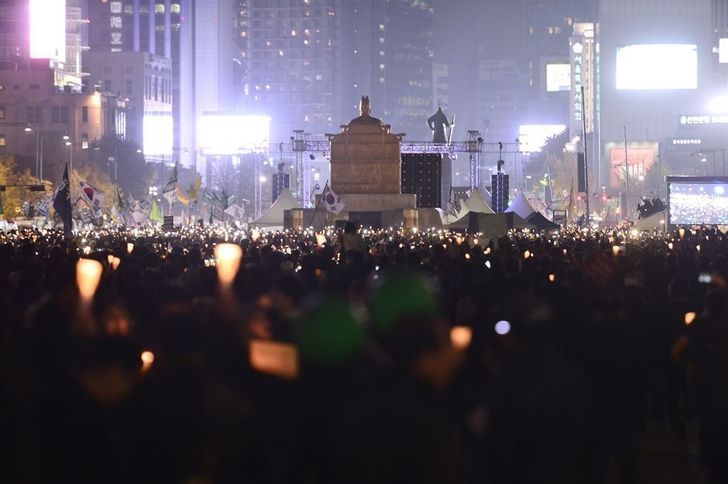
People participate in candlelit rallies calling for former President Park Geun-hye to step down at Gwanghwamun Square in central Seoul, Nov. 12, 2016. Korea Times photo by Shim Hyun-chul
By Lee Hae-rin
By Lee Hae-rin
Located within earshot of Cheong Wa Dae, the spacious area of Gwanghwamun Square is one of the most popular venues for protesters to gather and call for change. Its location near the presidential office makes it easier for them to make their voices heard. Partly because of this reason, there are protests there almost every day, from one-person rallies to large-scale demonstrations, as seen during the candlelit rallies in 2016 and 2017, which led to the impeachment of former President Park Geun-hye. Some have even installed makeshift facilities to stay there for longer-term protests.
“The main reason to hold a protest in Gwanghwamun Square is its proximity to Cheong Wa Dae. It's where a large number of people can gather and maximize the effect of collective action,” Oh Ho-suck, the co-representative of the national emergency association of small businesses against COVID-19, told The Korea Times, Monday.
“It is also easily accessible by public transport, which makes it easier for participants to join rallies,” Oh said, recalling the mass assembly he led there in February.
As Oh said, the square is geographically suitable for mass gatherings, with a 100-meter wide boulevard connecting with City Hall and linking with seven stations on four metro lines within a one kilometer radius. Several demonstrations that marked the country's recent timeline, including the candlelit rallies in 2016 and the #MeToo protests in 2018, have taken place there.
Following President-elect Yoon Suk-yeol's announcement to relocate the presidential office into Yongsan, however, Gwanghwamun Square might lose its luster as an iconic space for mass rallies. Yoon said the aim of the relocation is to communicate more closely with the people, a step largely welcomed by protesters including Oh who have been disappointed by previous administrations.
“The location (of the presidential office) shouldn't matter to us, the protesters. What matters the most is a leader's attitude and willingness to listen,” said a member of the COVID-19 vaccine victims' family union. He said the group delivered a letter to the President after parading through Gwanghwamun last Saturday and haven't received a response yet.
Unlike the group's wishes, the new location could hinder them from making their voices heard to the government due to its geographic conditions and existing law on assembly.
Seen is the Ministry of National Defense headquarters in Seoul's Yongsan District, which President-elect Yoon Suk-yeol said will be used as his presidential office. Yonhap
“Traffic jams here have always been an issue. There is no doubt that it will get worse if tens of thousands of protesters come here regularly to make themselves heard to the President,” said a food truck owner who has been running the business in the neighborhood for decades.
When compared to the Gwanghwamun area, Yongsan lacks a relatively large open public space to hold rallies and only has three metro stations from three lines within its one-kilometer radius.
The most prominent candidate protest locations here are at Hangang and Noksapyeong boulevards, estimated to be large enough to hold 100,000 and 50,000 people, respectively. But these are major roads and large rallies there could be restricted or forbidden due to public security, under the current Assembly and Demonstrations Act, according to the district's police.
The law requires protesters to pre-register for a specific time and venue with the district's police and receive authorization in advance. Police may not authorize protests under certain conditions, one of which is if the event could go against the public interest. If unauthorized, the protest is illegal.
In the face of these difficulties, the activists named the park that Yoon promised to build by the new office as their last resort. “We could make ourselves heard there (at the park) by the War Memorial Museum once it opens. I heard it'll be some millions of square meters large,” Oh said.
Unfortunately, the park's future availability for protesters also remains unclear, as the leader of Yoon's relocation taskforce said Sunday that “the park will be a rest area for the people and could have some restrictions in regards to holding demonstrations.”
In response, some alternative methods to hold demonstrations have surfaced.
Yong Hye-in of the minor Basic Income Party proposed an amendment to the relevant regulation to invite public opinion.
“Under the current law, the highly dense residential and commercial area near Samgakji Station is the only option left for protests,” Yong said at a press conference, Monday.
The law restricts assemblies and demonstrations within 100 meters of government properties including the National Assembly, Constitutional Court, embassies and presidential residence, although it has been declared unconstitutional by the Constitutional Court several times. Due to the restriction, protests have been moved away from Cheong Wa Dae and have been the source of complaints from nearby residents.
Seen is an online queer parade participated by over 12,000 people on Instagram in June 2020. The offline event was canceled under the COVID-19 pandemic situation. Screenshot from Instagram
Others suggest seeking creative alternatives to replace physical gatherings. “It is now a digital-centered era, in which there are several effective ways to deliver a message online. Offline protest may not be the only democratic method anymore,” Sungkyunkwan University sociology professor Koo Jeong-woo said.
The online parade campaigns by the LGBTQ community have proven a success during the last two years amid the coronavirus pandemic. The digital initiative went viral on social media and earned positive reviews among some local news outlets and the digital-savvy young generation, but garnered less attention than the usual physical gatherings.
While Yoon's transition committee made vague promises to arrange a place for communication, experts point out the importance of an open square in a democracy and highlight the need for more rational restrictions on protest authorization.
“The rights to assembly and demonstration are fundamental in a democratic society like Korea and should not be infringed upon under any circumstances,” Korea University sociology professor Kim Yoon-tae said.
Koo added, “We need to gather people's opinions and reach a consensus to build reasonable and rational regulations according to the changes in the circumstances for protests … People will find a way to make themselves heard, anyway.”