Major elections scheduled for next year
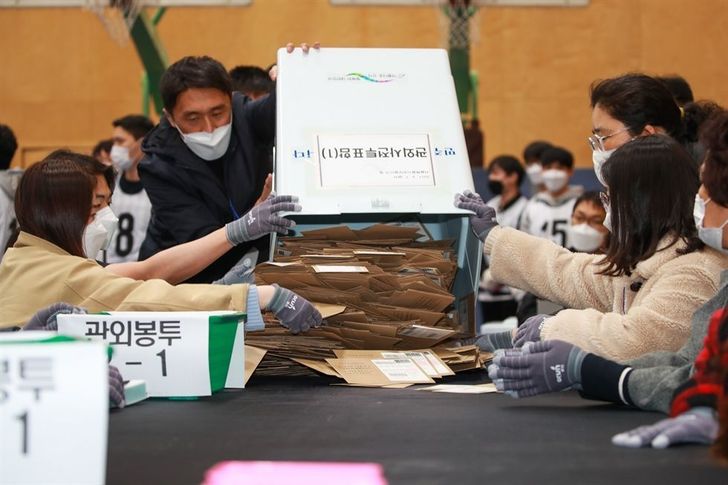
National Election Commission staff sort ballot papers for counting at a polling station set up in a high school in Seoul's Jongno District following the by-election for the Seoul mayor position, in this April 7 photo. Korea Times file
By Jung Da-min
A series of major elections will mark the year 2022, as not only the regular presidential election and local elections, but also unusual parliamentary by-elections for two major constituencies in Seoul, will take place following the recent stepping down of two lawmakers.
The presidential election is slated for March 9. Korea's presidential election used to be held in December and the president-elect's term used to start in the following February, but the last election took place on May 9, 2017, and President Moon Jae-in was inaugurated the next day, as it was an unprecedented snap election held after his predecessor Park Geun-hye was impeached over a massive corruption scandal.
On the same day as the presidential election, by-elections for two district government seats in Seoul will be held ― one for Jongno, which was the constituency of former liberal ruling Democratic Party of Korea (DPK) Chairman Lee Nak-yon, and the other for Seocho A, that of former conservative main opposition People Power Party (PPP) lawmaker Yun Hee-suk.
Lee gave up his post last week in order to concentrate on his presidential campaign fully. The former five-term lawmaker is running in the party primary. Yun also quit earlier this month over her father's alleged violation of the Farmland Act for real estate speculation.
Attention is especially being focused on Jongno, as this seat has political significance due to its history of being a stepping stone for potential presidential contenders.
Several political heavyweights from both the liberal and conservative blocs are being mentioned as potential candidates.Those running in the Jongno by-election representing the DPK and the PPP, in particular, are expected to team up with the presidential candidates of each party, as the two elections are to be held on the same day.
Among those mentioned as potential contenders for the Jongno district are PPP Chairman Lee Jun-seok, who has never won an Assembly seat but surprised political circles and the public by becoming the youngest-ever leader of the conservative main opposition party. So far he has dismissed such speculations, saying that he is committed to his election campaign in the Nowon District of Seoul, where he is vying to win an Assembly seat.
From the ruling bloc's side, Im Jong-seok, former chief of staff to President Moon Jae-in, and Park Young-sun, former minister for SMEs and startups, are seen as potential runners.
Political watchers further expect that the results of the presidential and Jongno by-elections will affect the subsequent local elections on June 1 to select the leaders of local governments across the nation, including the mayoral posts of the country's two major cities, Seoul and Busan. These elections in the country's two largest cities have been considered a barometer of public opinion on the political parties.
In the April 2021 by-elections for the mayoral posts of Seoul and Busan, the PPP had a landslide victory against the DPK. Some attributed the DPK's defeat to dissatisfaction with the ruling bloc's real estate and economic policies, as well as a scandal involving employees of the state-run housing developer, the Korean Land and Housing Corp. (LH).