Main opposition party leadership blamed for lacking strategy, causing internal rifts
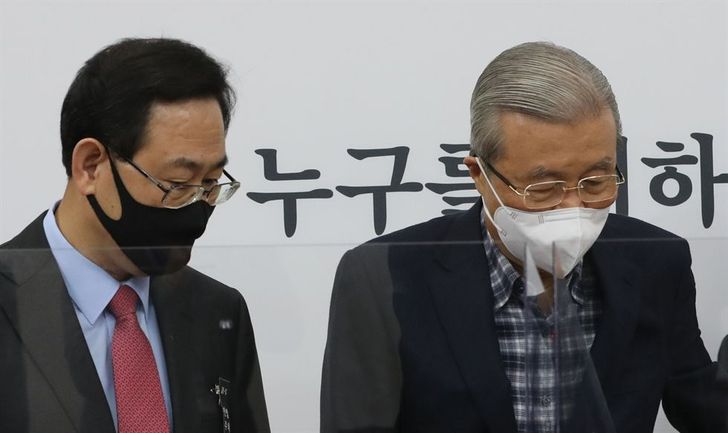
Main opposition People Power Party's emergency committee chief Kim Chong-in, right, and floor leader Rep. Joo Ho-young attend a party meeting at the National Assembly in Seoul, Sunday. Yonhap
By Jung Da-min
Criticism is rising over the leadership of the main opposition party, as it has made very few political accomplishments while struggling to hold the ruling bloc in check.
As the ruling Democratic Party of Korea (DPK) is strongly pushing ahead with the passage of controversial bills using its supermajority in the National Assembly, the main opposition People Power Party (PPP) has staged filibusters in an attempt to stop the DPK's moves.
But the PPP's protest has had little effect. Its first filibuster to prevent the vote on a revision bill to the law on a new investigative body for high-profile corruption cases, Wednesday, finished only about three hours later when the plenary session of the Assembly ended for that night. The very next day, the DPK convened an extra session and passed the bill, as holding a second filibuster for one bill is impossible by law.
As critics accused the DPK's move of damaging the spirit of democracy, the DPK changed its stance saying it would guarantee the PPP's right to stage a filibuster for a “sufficient” period of time. The PPP then began another filibuster, Thursday, to prevent the passage of a different bill on the reform of the National Intelligence Service (NIS), and plans to stage another for a law banning the sending of anti-North Korea leaflets to the North.
But criticism grew within the PPP that the filibusters since Thursday have been belated and meaningless, as the major contentious bill on the new anti-corruption investigative body had already been passed.
Furthermore, the PPP's filibusters can be stopped anytime when the DPK, which has 173 of 300 seats in the Assembly, seeks to stop them in alliance with several lawmakers of the other minor liberal parties. It needs 180 seats, or three-fifths of the Assembly members, to halt a filibuster.
The leadership of the PPP is under internal criticism for lacking a strategy to stop the DPK's moves but remains powerless. Adding fuel to the fire, the party is experiencing an internal feud over how to deal with the wrongdoings of former presidents of the conservative camp, Lee Myung-bak and Park Geun-hye. Both Lee and Park were convicted for corruption and put behind bars.
The PPP's emergency committee chief Kim Chong-in has been planning to issue a public apology for the crimes of Lee and Park, vowing to the public that it would push ahead with reforms of the conservative camp. But Kim's move faced backlash from some party members who say such a public apology would send the wrong signal to conservative backers. Facing backlash, Kim decided to put off the public apology until after the filibusters finish.
Another internal rift has risen from PPP floor leader Rep. Joo Ho-young's recent attendance at a meeting among minor far-right parties and civic groups who have staged rallies to support the imprisoned Park, with the national flag ― Taegukgi ― being their symbol. Joo's attendance is seen as a move to unite the country's conservative bloc against the ruling bloc.
But many PPP members criticized the move, which they view could give a negative impression to the public as people may think the main opposition party is still not ready for a new start.