High-profile defector, veteran liberal politician in rare match in Gangnam
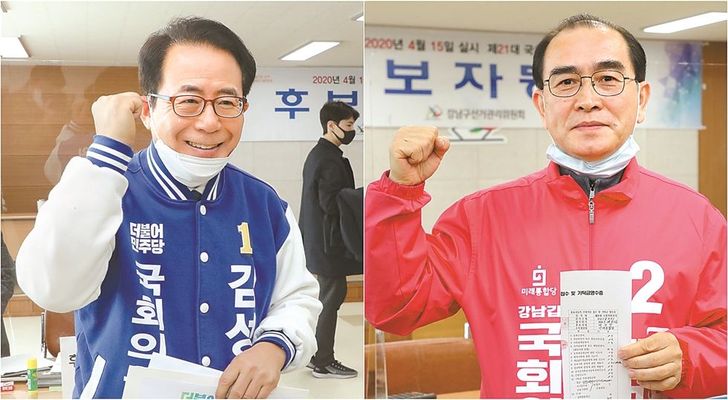
Kim Sung-gon of the ruling Democratic Party of Korea, left, and Tae Ku-min of the main opposition United Future Party pose after formally registering as candidates running in the Gangnam-A constituency in the April 15 general election, at a regional branch of the National Election Commission in Gangnam-gu, Seoul, March 26. Yonhap :
This is the third in a series on battleground districts for April 15 general election. ― ED.
By Jung Da-min
A “rare” competition between a high-profile North Korean defector and a veteran liberal politician is being held in Seoul's Gangnam-A district in the April 15 general election.
Thae Yong-ho, a former senior North Korean diplomat who defected to South Korea in 2016, is a candidate on the ticket of the main opposition United Future Party (UFP). He is running in the election under his new name Tae Ku-min.
Standing against Thae from the ruling Democratic Party of Korea (DPK) is Kim Sung-gon, a former four-term lawmaker who held the National Assembly secretary-general position in 2018.
The race between the two has drawn attention for its symbolic meaning, as Gangnam is seen as representative of South Korean capitalism and conservatives.
Long considered home territory for the conservative camp, no candidate from a liberal party has won in the Gangnam-A district since 2000. But the election result is hard to predict as Kim has been working steadily to woo voters since the previous general election in 2016 when he narrowly lost but gained a respectable 45.18 percent of the vote. At the same time, the district is undergoing a generational shift which may indicate a shift toward liberal parties.
While Thae has an advantage as a candidate of the conservative camp, critics say that residents might feel reluctant to vote for him as he has lacks a connection to and experience of the district as a person from North Korea.
Thae is the first North Korean defector to run in an election as a constituency candidate. Cho Myung-chul was the first defector to enter the National Assembly, after gaining a proportional representation seat in 2012 for the then-ruling Saenuri Party.
Kim Chong-in, a veteran economist and politician, had criticized the UFP's nomination of Thae for the constituency citing the matter of connection, saying the nomination of Thae was a “national shame” and that Thae is a “person without roots in South Korea.” In response, Thae said he is a South Korean citizen who can run for an election in accordance with the Constitution.
The conflict between Kim Chong-in and Thae however, has come to an end and as leader of the UFP's campaign committee, Kim pledged to support Thae.
For Kim Sung-gon, his long-time experience as a politician could give him an advantage over Thae, but Gangnam residents' criticism of the Moon government's real estate policy, which has imposed a higher tax burden on them than before, could be a weak point.
But Thae is not in an advantageous position over the issue either, as Gangnam residents doubt that Thae has the capability to deal with capitalist issues.
Both candidates promised that they would lower the comprehensive real estate holding tax for single households and longstanding residents.
Security-related issues could also be on their respective campaign agendas, as the two candidates are both well-versed on the topic.
After defecting to the South in 2016, Thae worked as an advisory researcher at the Institute for National Security Strategy (INSS) under the National Intelligence Service (NIS) before resigning in May 2018.
Thae has criticized the Moon Jae-in government's security policies for giving a “boost” to the Kim Jong-un regime while pursuing policies of “appeasement.” He said the reason for his election bid was that he wanted to change the administration's North Korea policy, which he argues is going in the wrong direction, and that a win by a North Korean defector in such a constituency would show the maturity of South Korea's democracy.
Kim Sung-gon served as the chairman of the National Defense Committee at the National Assembly from 2006 to 2008 and was engaged in defense and security-related legislation and policymaking. He is also the brother of Robert Kim, a Korean American, who was jailed for passing U.S. military secrets to South Korea while working as a civilian Navy intelligence analyst with access to highly classified information.