Ruling party to join progressive 'big tent'
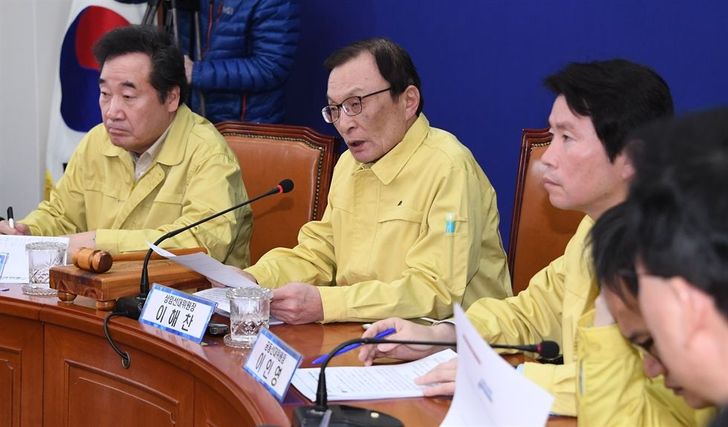
Ruling Democratic Party of Korea (DPK) leader Lee Hae-chan speaks during a party meeting at the National Assembly in Seoul, Friday. The DPK announced it will join a progressive coalition of civic groups and minor liberal parties to create a separate party to run for the proportional representation seats in the April 15 general election. Korea Times photo by Oh Dae-geun
Opposition parties condemn DPK for creating 'quasi-satellite' party
By Jung Da-min
The ruling Democratic Party of Korea (DPK) announced Friday that it will join a progressive coalition of civic organizations and minor liberal parties to create a separate party in a bid to gain more proportional representation seats in the upcoming general election.
The decision runs counter to the ruling party's initial stance that big parties should not set up “paper parties” under the revised electoral system which gives more proportional representation seats to minor parties. It said the decision was an inevitable response to the same tactic being used by the main opposition party.
The DPK put the issue to a vote of 789,000 party members with rights to participate in its primaries, over 24 hours between Thursday and Friday morning. Around 241,000 of them cast ballots, and 74.1 percent said the DPK should join the coalition.
“The party leadership is taking the 74 percent approval rating as overwhelming support,” DPK chief spokesman Kang Hoon-sik said in announcing the vote result at the National Assembly press center.
The decision came after many discussions among party members as some strongly opposed the move, saying the DPK could lose the trust of the public and other minor parties it partnered with to pass the electoral reform bill in December.
At the time, the then-main opposition Liberty Korea Party (LKP), which is now a part of the United Future Party (UFP) after a merger with other minor conservative parties, strongly opposed the bill but later created a satellite party to get more proportional representation seats, under the name Future Korea Party in early February. The satellite party is expected to rejoin the UFP after the election.
DPK leaders said their move was an inevitable choice to respond to the cheating by the UFP.
“We regard the overwhelming consent from party members as a show of support to punish the UFP's foul and anti-reform move, and to continue to carry out the reform of state administration,” DPK Chairman Lee Hae-chan said at a party meeting at the Assembly.
The decision immediately drew criticism from other parties.
“The DPK has left an indelible dishonor in the history of Korean politics,” said UFP spokesman Park Yong-chan in a statement. “It deceived citizens without making any apology over breaking a promise it made with the tattered election bill, blinded by the calculation of votes for the election.”
Other minor parties who had partnered with DPK to pass the election reform bill, including the Justice Party and the Minsaeng Party, also condemned the DPK's “foul.” They said the DPK joining the liberal coalition was no different from it creating its own satellite party.
When the then-LKP, now the UFP, created its satellite party, the DPK has strongly condemned the move as being against the purpose of election reform.
However, the DPK leadership changed its stance stating that it needed to explore “other options” over concerns that it could lose its majority in the Assembly to the conservative “big tent.”
Former Prime Minister Lee Nak-yon, who co-leads the DPK's strategy committee for the election, has been condemned for his recent remark that “criticism stays for a moment, but responsibility is much longer.”