Parties seek different North Korea policies
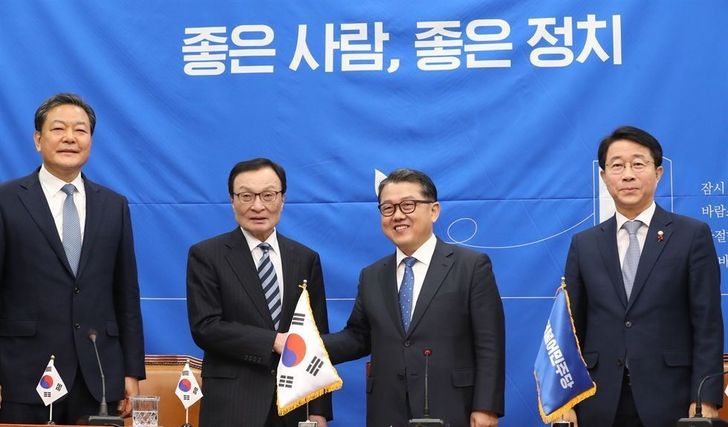
The ruling Democratic Party of Korea chief Rep. Lee Hae-chan, second from left, shakes hands with retired Army Gen. Kim Byung-joo, who was a former deputy commander of the Republic of Korea-U.S. Combined Forces Command and joined the party ahead of the 2020 general election, Thursday, at the National Assembly.
By Jung Da-min
The ruling Democratic Party of Korea (DPK) and the main opposition Liberty Korea Party (LKP) are pursuing different policies toward North Korea. The DPK has emphasized the importance of continuing dialogue in 2020, while the LKP criticized this engagement policy for bringing no results.
The two parties showed different reactions to North Korea's New Year message which implied the possibility of resuming the tests of strategic weapons such as nuclear weapons or intercontinental ballistic missiles (ICBMs).
North Korea delivered this message on New Year's Day announcing the results of the 5th plenary meeting of the 7th Central Committee of the country's ruling Workers' Party of Korea, which lasted for four days from Dec. 28 to 31.
The DPK has emphasized the need to restore the momentum of inter-Korean dialogue, acknowledging that the current relations between the two Koreas are in a difficult situation, as are North-U.S. relations.
“North Korea's resuming of ICBM or nuclear weapons tests or developing new strategic weapons to escalate the tensions would not only threaten the peace on the Korean Peninsula but also harm the North itself too,” the DPK's top spokesman Rep. Hong Ik-pyo said. “The North should return to its original intention in 2018 when it was developing the dialogue momentum (with the South).”
But the LKP highly criticized President Moon Jae-in's engagement policy toward the North.
“The government has consistently pushed ahead with its engagement policy toward the North while government officials have represented the North Korean side numerous times,” LKP spokesman Lee Chang-soo said. “The North never mentioned our government or inter-Korean relations. It is a shame that our President has emphasized the South's role as a driver. It is a passing of the South and the Moon Jae-in government.”
The main opposition Liberty Korea Party chief Hwang Kyo-ahn, second from left, speaks during a Supreme Council meeting of the party, Thursday, at the National Assembly. Yonhap
Other minor opposition parties called on the North to stop activities that threaten peace on the peninsula and the government to continue diplomatic efforts to establish peace.
Meanwhile, the DPK also called on the LKP to return to the National Assembly and continue to negotiate over political issues.
After two controversial bills on electoral and judiciary reform were passed at the National Assembly late in December despite strong opposition by the LKP, the LKP members vowed to resign en masse, though the plan is unlikely to be realized under the legal proceedings of the Assembly.
Several months ahead of the 2020 general election on April 15, a sense of crisis is spreading within the conservative side.
The LKP is planning to unite parties under the flag of conservatism to win the elections, LKP leader Hwang Kyo-ahn told reporters during a New Year luncheon. A new party splintered from the minor opposition Bareunmirae Party, led by Rep. Yoo Seong-min, also expressed sympathy for the need to unite the right-wing parties.
The LKP also decided to welcome back those who left the party for the sake of integration, during a Supreme Council meeting, Thursday.
The DPK is also gearing up for the elections scouting new figures for the party. Most recently, retired Army Gen. Kim Byung-joo, who was a former deputy commander of the Republic of Korea-U.S. Combined Forces Command (CFC), joined the DPK, the party announced Thursday. Retired U.S. Army Gen. Vincent Brooks, who formerly headed the CFC with Kim, sent a congratulatory letter.
Kim vowed to help the Moon administration's defense policies, especially its efforts to keep the Korea-U.S. alliance strong.