Major, minor parties divided over special activity funds
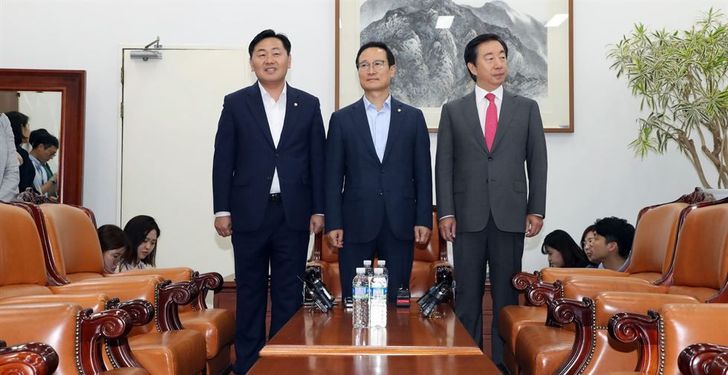
Floor leaders look to different sides before having a meeting to discuss the special activity funds in the National Assembly, Wednesday. Parties are in dispute over the funds, whether to abolish them or reveal the expense details instead. Yonhap
By Park Ji-won
Concerning lawmakers' special activity funds and the redrawing of precincts, major and minor parties are locked in a dispute after the recent court decision to reveal the details of the past use of those funds.
While the ruling Democratic Party of Korea (DPK) and major opposition Liberty Korea Party (LKP) insist on keeping the funds and disclosing the receipts for expenses instead, the minor opposition Bareunmirae Party (BMP) and Justice Party continue to claim the funds by law shouldn't be given to lawmakers.
The DPK and LKP are hesitant to give up the funds, saying they prefer to continue receiving the funds and submit receipts.
“We haven't decided whether to cut or keep the funds but can say we will make it public by submitting our receipts,” DPK spokeswoman Park Kyung-mi said.
“Basically, we are making it into an obligation to submit the receipts of the funds,” LKP spokeswoman Shin Bo-ra said.
However, the minor parties made it clear they are against receiving those funds.
The BMP set abandoning the special activity funds as one of the party's main goals and decided to return to the Assembly Secretariat the funds it received.
Lee Jeong-mi, chairwoman of the minor progressive Justice Party which was the first party to insist on the abolition of the funds, said “the shipment of envelopes from unclear sources helped us to distort our politics. The Justice Party will do our best to pass the bill abolishing the special activity funds.”
The parties' division came after the People's Solidarity for Participatory Democracy, a civic organization, released a report about the details of “special activity funds” spent at the National Assembly from 2011 to 2013.
According to the report, about 8 billion won is set aside in the Assembly budget every year in the name of special activity funds.
“The expenses for activities for the Assembly are already allocated in the yearly budget. We urge the National Assembly to return the funds instead of making it public by submitting receipts, and then cut all the funds from the budget for next year,” the civic organization said.
Usually the nation's spy agency has a budget allocated for a special activity fund and the agents do not need to report how the money is used because their work often involves secret activities.
Under the law, high-profile lawmakers, however, such as major party leaders and standing committee chiefs, could receive special activity funds for “research or for National Assembly diplomacy purposes.”
Also, the latest data by the same organization shows, Wednesday, former Rep. Hwang Woo-yea, then floor leader of the conservative Hannara Party and Saenuri Party, received 6.23 billion won ($5.58 million) during the given period while Rep. Park Jie-won, then floor leader of the Democratic Unity Party (DUP), received 5.91 billion won.
Meanwhile, the division continues in redrawing precincts. The voting system is presently in favor of the major parties in that the winner of the majority of votes wins its precinct. Under the system, the minor parties hardly win any precincts and asked for a revision of the law to win the number of precincts according to the proportion of the winning votes.
Chung Dong-young, newly elected chairman of the Party for Democracy and Peace (PDP), said the party will push for the revision of the electoral system according to the proportion of votes per each party, urging the ruling party to make up its mind to do so.
“If the electoral system doesn't change, the politics don't change. If the politics don't change, the people are unhappy,” Chung Dong-young said to reporters Sunday.
“If the ruling DPK makes up its mind to do so, the system will be reformed.”
Whether the DPK and LKP would agree to change the related law is unclear. If the law is changed to follow the proportion of winning votes, the DPK and LKP could lose 46 and 21 seats at most in the 20th National Assembly, according to simulation data of the National Assembly Research Service.