Most Koreans don't see war on the horizon
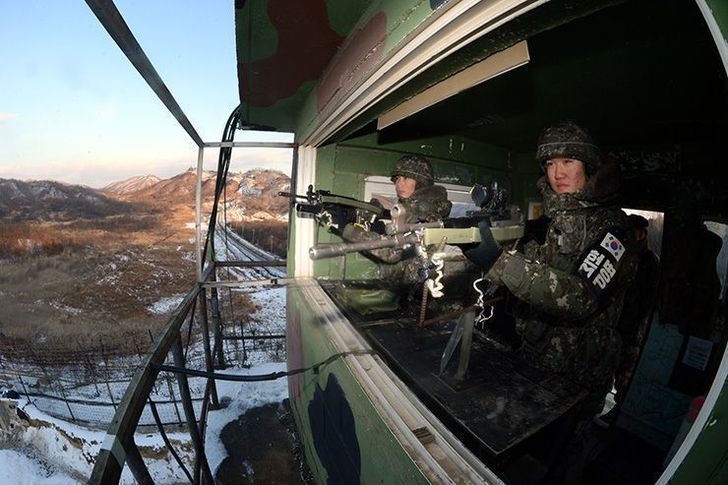
Fear of war with North Korea runs second to concerns about poverty in a recent survey of 1,000 people. In this photo taken on Christmas Day 2014, armed South Korean forces stand guard at a post facing the Demilitarized Zone. / Korea Times file
- Poverty is top concern
-
Two-thirds of young generation think reproduction is option
By Oh Young-jin
The world sees the Korean Peninsula as a powder keg that may go up in flames any minute amid U.S.-North Korean brinkmanship, but most Koreans don’t agree with that assessment.
According to a recent survey, 54 percent of Koreans see a low or very low chance of war, while 39 percent think there is a high or very high chance.
Koreans also fear the breakout of war less than poverty. A second Korean War comes second at 24 percent in the survey, preceded by poverty at 37 percent. Prejudice and discrimination is third at 19 percent.
The survey questioned 1,031 people. MBC TV and the office of the National Assembly speaker commissioned it.
Demographics played a key part. Fear of war was top among those aged over 60 who experienced the 1950-53 Korean War or were affected by it.
Those who see war unlikely are evenly spread by region but Gyeongsang areas, the bastion of political opposition and conservatism, buck the trend, with more people fearing the outbreak of war. Gangwon Province, where the 2018 PyeongChang Olympics is scheduled for February, has a “hung jury.”
Asked who their favorite foreign leader is, Germany’s Chancellor Angela Merkel tops the list at 43.2 percent, U.S.
President Donald Trump gets 9 percent and Chinese President Xi Jinping 7 percent. Russian President Vladimir Putin and Japanese Prime Minister Shinzo Abe followed.
In previous surveys, Barack Obama, when he was in office, often led the pack.
About children, 64.2 percent backed having one child or more, double the number of those who think otherwise. Two-thirds of those in their 20s and 30s think reproduction is optional.
Ninety percent in their 60s, 82 percent in their 50s and 61 percent in their 40s think children are a must. A higher percentage of men prefer to have children than women.