'Gwangju prison was secret burial site in 1980'
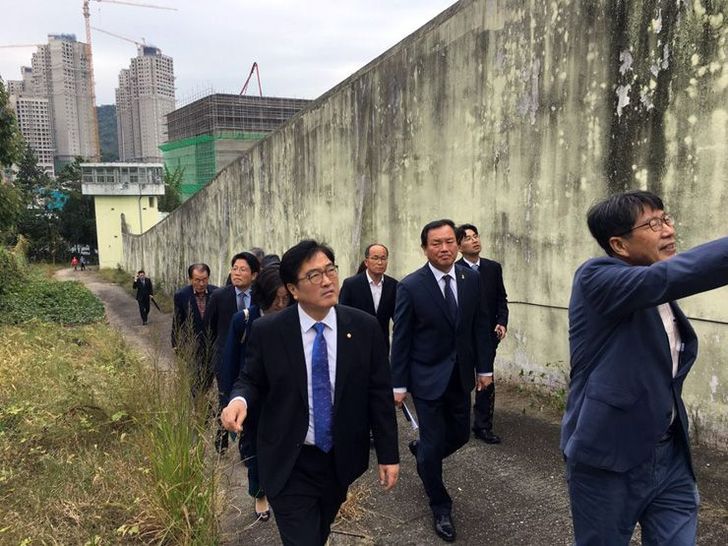
Rep. Woo Won-shik, left, floor leader of the ruling Democratic Party of Korea, looks around a prison in Gwangju along with members of the May 18 Memorial Foundation, Tuesday. A team led by the foundation is looking into allegations that the military junta led by then-Army general Chun Doo-hwan secretly buried bodies in the prison following a bloody crackdown on a pro-democracy movement in 1980. / Yonhap
By Jun Ji-hye
A team led by a Gwangju-based foundation began a government-approved investigation, Wednesday, of an old prison in the southwestern city based on tips that bodies were secretly buried there during the military junta’s deadly crackdown on a pro-democracy movement in 1980.
Based on the investigation, the government will decide whether to excavate the site.
Officials from the Ministry of Justice, excavation experts and people claiming to have witnessed the burials are participating in the two-day probe led by the May 18 Memorial Foundation. Ruling Democratic Party of Korea (DPK) floor leader Rep. Woo Won-shik also accompanied the team.
The team has gathered testimony and old memos written by paratroops stationed at the prison during the Gwangju Uprising.
The team said it will announce the results of its inspection and future plans on exhuming any remains later.
According to documents written by the military at the time, 28 protesters died while “making an incursion into the prison.”
So far, 11 bodies have been found. The foundation believes the remaining bodies were buried somewhere near the prison.
“We have asked the prosecution to begin an investigation once the remains are unearthed,” said Kim Yang-rae, the executive director of the foundation.
The military-backed Chun Doo-hwan government of the time ordered the deadly operation against the pro-democracy protesters.
Chun, an Army general at the time, had seized power through a military coup, Dec. 12, 1979, after the assassination of President Park Chung-hee, the father of recently ousted President Park Geun-hye.
The military used deadly force in response to Gwangju citizens rising up against Chun’s rule, May 18, 1980. Chun later became president in September that year.
The foundation said it will also push for excavation of other victims in other places within the year.
Eighty-two protesters are on the official record of missing persons from the uprising. Among them, the remains of six have been found and through genetic analysis returned to their families.
Rep. Woo said the ongoing investigation should be the starting point to unearth the facts behind the tragedy.
“A number of truths have been covered up,” he said. “Various civic groups in Gwangju have made consistent efforts to find the truth, and this led to today’s inspection.”
Referring to a bill for a special law to uncover the truth behind the bloody incident, jointly submitted by the DPK and the minor opposition People’s Party, Woo urged the conservative opposition Liberty Korea Party to join hands to pass the bill.
The investigation by the civic group is in line with the Moon Jae-in government’s effort to look into the military junta’s deadly crackdown on citizens.
On Aug. 23, President Moon ordered a special probe into two allegations that the military led by Chun ordered machine-gun fire on citizens from helicopters and that the military even considered deploying fighter jets to bomb the city.
In accordance with the order, the Ministry of National Defense formed a special investigative team to look into the details.
Earlier, cable TV network JTBC quoted former Air Force pilots, who were serving at an air base in Suwon, as saying they were ordered to stand by with their fighter jets loaded with MK-82 bombs three to four days after the outbreak of the uprising.
The pilots said they were told their destination was Gwangju and that a riot instigated by North Koreans was taking place there.
For their part, civic groups have been consistently claiming there were shots fired from military helicopters at the Jeon-il Building which was used as a base for demonstrators.
In January, the National Forensic Service found about 150 bullet holes in the building, believed to have been fired from a helicopter.
During the presidential campaign in March, Moon visited the building and vowed a thorough investigation.
The Seoul Central District Court sentenced Chun to death in 1996 for the bloody crackdown that resulted in hundreds of deaths, but the Supreme Court reduced the sentence to life imprisonment in 1997.
Then-President Kim Young-sam pardoned him in December the same year under his “grand national harmony” campaign.
Chun and his aides still deny responsibility for the bloody suppression of the democratic movement.