Cambodian hotel under US sanctions remains open as tourism, crime coexist in Sihanoukville
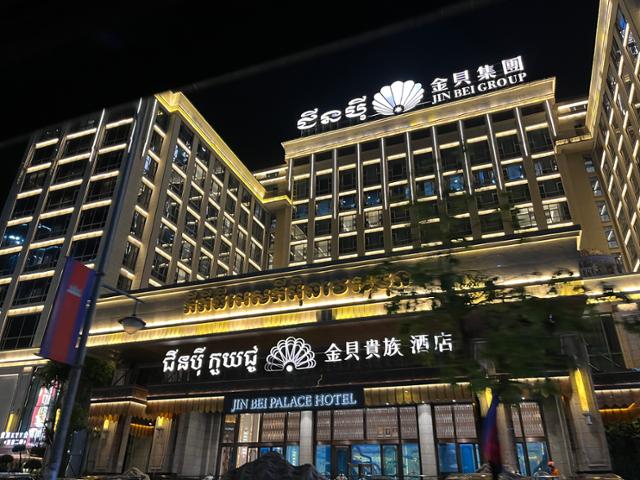
Jin Bei Palace Hotel in downtown Sihanoukville, Cambodia, part of Prince Group, which was sanctioned by the United States and United Kingdom on Wednesday. Hankook Ilbo
SIHANOUKVILLE, Cambodia — On the night of Oct. 15, the five-star Jin Bei Palace Hotel in downtown Sihanoukville, Cambodia, was brightly lit and bustling with activity. The seven-story building, featuring more than 200 luxury rooms and a large casino, was packed with Chinese-speaking guests as luxury cars pulled up in front, one after another.
The hotel belongs to Prince Group, which was placed under sweeping sanctions by the United States and the United Kingdom the same day. The two governments said that the conglomerate operates at least 10 scam networks in Cambodia and has engaged in large-scale human trafficking and torture. The sanctions targeted 117 affiliates of the group and its Chinese-born, chairman Chen Zhi, 38, along with the group’s casino and hotel subsidiary, Jin Bei Group.
The hotel continued to operate. When this reporter revisited the next morning and asked whether it remained open despite the sanctions, an employee said, “I don’t know anything about that,” before quickly ushering the reporter outside. While the hotel appeared normal on the surface, locals say it has long been known to contain a “wench” — a slang term in Southeast Asian crime circles referring to a compound where illicit activities occur.
The term wench derives from the Chinese word “yuanqu,” meaning industrial park, but is used to refer to these scam compounds. “In reality, almost every casino has one,” said a Korean resident. “There are cases where foreigners, including Koreans, are forced to work inside these compounds after being trapped due to gambling debts.”
KB Hotel in Sihanoukville, Cambodia. Behind the hotel stands a building believed to be used for voice phishing operations. Both properties belong to Chinese national Xu Aimin, who was sanctioned by the U.S. Treasury last month. Hankook Ilbo
A city where tourism and crime coexist
Signs of Prince Group’s presence were visible across the city. A local resident pointed to Sihanoukville’s largest shopping mall in the city center. “That used to be called Prince Mall,” he said. “About six months ago, they suddenly changed the name to U Mall.” On one side of the building’s exterior, the Chinese characters for “prince” still remained.
Other areas of Sihanoukville show similar patterns. Near the Gulf of Thailand stands the eight-story luxury KB Hotel, adjacent to a gray commercial building guarded by muscular security men. Both properties belong to Xu Aimin, 63, a Chinese national who fled his country after being sentenced to 10 years in prison in 2013 for running an illegal online gambling ring. Interpol has issued a Red Notice for his arrest.
Xu was also added to the U.S. Treasury Department’s sanctions list last month. U.S. authorities say foreigners have been confined in his buildings and forced to participate in online fraud schemes. Among the victims, many are believed to be young Koreans who were lured and detained to work in voice phishing operations.
These accounts reveal the grim reality of a city where luxury hotels and criminal industries coexist.
Prince Group Chairman, Chen Zhi, a Chinese businessman sanctioned by the United States and the United Kingdom on Wednesday / Captured from Prince Group Holdings website
Illegal activities thrive after COVID-19
Sihanoukville was not always known as a crime-ridden city. Once hailed as a hidden coastal gem of Southeast Asia, it began to change drastically in the mid-2010s when massive Chinese capital poured in under Beijing’s Belt and Road Initiative. Grand hotels and casinos sprang up one after another.
Flooded with Chinese capital, Sihanoukville became a “Little China.” Chinese-language signs now outnumber Khmer ones, and if not for Cambodian flags on the streetlights, one could easily mistake the city for a Chinese metropolis. Even locals often speak fluent Mandarin when addressing visitors.
Oh Chang-soo, head of the Korean community in Sihanoukville, said, “About six or seven years ago, Chinese property developers came here by the busload, and land prices skyrocketed to levels similar to Shenzhen.” He added, “Even now, nine out of 10 large buildings in the city are owned by Chinese investors.”
A Chinese restaurant operates in downtown Sihanoukville, Cambodia, on Wednesday. Hankook Ilbo
The atmosphere shifted dramatically after the COVID-19 pandemic. As tourism collapsed, many hotels shut down, only to be purchased by Chinese-run criminal syndicates. These groups converted the properties into bases for online gambling, voice phishing and romance scams.
They reportedly recruit or abduct foreigners under the pretense of high-paying jobs, then traffic and confine them to carry out online fraud under coercion. Some community leaders claim that at least 200 Koreans are currently being held in such compounds across Sihanoukville.
Illegal advertisements are visible throughout the city. Posters in Chinese along the roads promote “software development” or “precision chat-based financial services,” while others recruit “Chinese-speaking female workers from the Philippines, Laos and Cambodia.” Local residents warn that these seemingly normal job postings are often fronts for illegal gambling, money laundering or human trafficking for prostitution.
Chinese-language flyers reading “platform and software development,” “precision chat-based financial services,” and “cryptocurrency-related system development” are seen on a street in Sihanoukville, Cambodia, on Wednesday. They are believed to be linked to illegal gambling, money laundering or fake trading systems. Hankook Ilbo
This article from Hankook Ilbo, the sister publication of The Korea Times, is translated by a generative AI system and edited by The Korea Times.