When 'escape game' becomes real situation
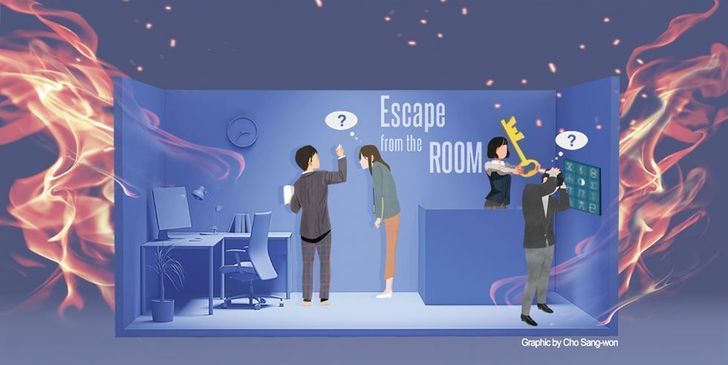
By Jung Hae-myoung
A couple, or a group of people, pour over a set of clues in a dark room they are locked in. They focus on solving problems with the clues in order to escape the room within a set time limit. But, until all clues are solved, the customers cannot get out, and while they may be enjoying the fun of escaping, it is easy for them to overlook the fact that they are locked in.
If a fire breaks out, it is even more difficult for customers to get out because some buildings have maze-like elements as part of the game. Also, in some escape rooms, it is hard to figure out the location of the exit because the players are left blindfolded after having been led into the room by a staffer.
On Jan. 5, five teenagers locked in an escape room in Poland were killed in a fire; while a man in his 20s was severely injured and hospitalized.
The Polish government ordered fire safety inspections of over a thousand such facilities after the tragedy, and the government here also became concerned as escape rooms have become popular among Korean youngsters.
The business is also a legal blind spot for fire safety, as it is registered as a “private business” in Korea, not a “business used by crowds.”
For private businesses, the fire authorities can advise the operators to install fire safety equipment such as sprinklers and extinguishers, but cannot order them to do so. For businesses used by crowds, it is mandatory for the operators to undergo fire safety education, install the equipment, and have regular inspections.
“As new types of businesses are emerging, some do not fall under the Fire Services Act even though they are used by many people,” Lee Yoon-geun, the head of the Fire Prevention Division of the National Fire Agency (NFA), said.
In one escape game venue near Hongik University Station in Seoul, the manager said the fire authorities came to the site to check its fire safety system Jan. 16.
“We have fire detectors in each room and exit signs, too,” the manager surnamed Choi said.
“We have to monitor the rooms anyway because some customers break property to find the clues,” she added.
Although the venue had fire extinguishers and detectors, sprinklers and emergency hammers were nowhere to be seen.
Officers from Gangwon Fire Headquarters inspect the standpipe system at an escape room building in Chuncheon, Gangwon Province, Jan. 8, after five teenagers died from a similar facility in Poland. / Yonhap
The government has been discussing safety issues regarding the business, but only recently formed a response team following the Polish tragedy.
The NFA said last week it would conduct fire risk assessments on all escape game businesses, and strengthen rules on fire safety, which may involve changing business categorizations.
It also had a meeting with CEOs of seven escape game franchises to emphasize the importance of fire safety rules, urging them to voluntarily install escape systems voluntarily.
“The fire authorities should have a clear standard for hazards, especially for constructions located underground or that have closed structures, because they have a higher chance of danger,” said Lee Young-joo, a professor at the Fire Emergency Management Department at the University of Seoul.
“The escape game venues can set up an automatic system in which the rooms brighten up or the doors unlock if a fire breaks out, so that people can quickly get out,” Lee added.
Escape room games first started in Japan in 2007 and became a trend among young people, with the business expanding to Europe, the United States and Asia.