Microplastics threaten dinner table in Korea
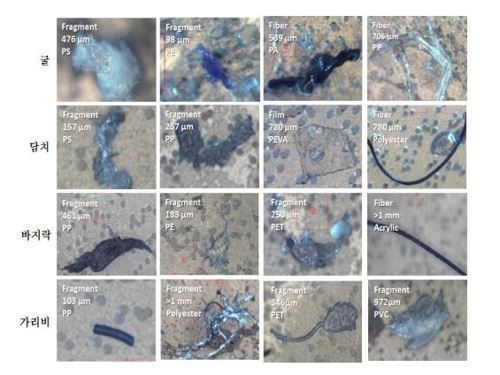
Fragments of microplastics were found in four types of seafood ― oyster, mussel, Manila clam, and scallop ― according to a study by the Korea Institute of Ocean Science and Technology. /Yonhap
By Jung Hae-myoung
Korea has been struggling to ban plastic use at cafes and restaurants, but even without plastic cups or straws, the material is already on the table, in an invisible way.
Recent studies have shown that microplastics are in seafood and even in salt. Microplastics are small plastic debris, less than 5 millimeters long, according to the definition by the U.S. National Ocean Service. Usually decomposed from disposed of plastic objects, they can be harmful to the oceans and aquatic life.
According to research on food safety management, conducted by the Korea Institute of Ocean Science and Technology last year, 14 different kinds of microplastics were found in mussels, scallops and four types of clams, sold at seafood markets in Seoul, Gwangju and Busan.
In 100 grams of Manila clams, there were 34 microplastics and 12 each were found in mussels and scallops.
Microplastics can originate from plastic particles contained in toothpaste and face wash, or from decomposed plastic bottles, clothes made of synthetic textiles and car tires. Cigarette filters also make up a large portion of plastic pollution in the ocean, up to 21 percent of all ocean waste picked up on 32 shores in Korea, according to the Maritime Rescue and Salvage Association.
Those not filtered from sewage flow into the ocean and rivers. They are broken down into small pieces which look similar to krill that fish eat. People, at top of the food chain, cook fish containing the microplastics.
If the plastics accumulate too much in blood vessels, they block blood flow. Fungi or infections can grow on the surface of microplastics, which may also contain harmful chemicals such as bisphenol A and DDT.
Some microplastics that are smaller than 150 micrometers can be absorbed by the lymph system, although the possibility is less than 0.3 percent.
The plastics are found not only in sea creatures. In 2015, China discovered more than 550 microplastics particulates inside 1 kilogram of solar salt, which is deemed “healthy” among Koreans.
A study by Mokpo National University released in September showed two domestic salt products and six imported ones contained microplastics.
Microplastics are also found in tap and drinking water as well. In 2017, the Ministry of Environment found 0.2 to 0.4 microplastics per liter in tap water in Seoul, Incheon, and Yongin in Gyeonggi Province.
Rep. Choi Do-ja of the Bareunmirae Party called for strong restrictions on microplastics.
“Our dinner table is no longer safe from microplastics,” Choi said. “Although the amount we consume may be very small, the problem is we are consuming it continuously from various sources. Proper research and government regulation is urgent at this point.” Choi said.
The Ministry of Oceans and Fisheries said there are no regulations, both here and abroad, about permissible levels of microplastics in food. “We'll try to find countermeasures through discussions with related ministries, as it is a worldwide issue,” a ministry official said.