Crimes by elderly on sharp rise
By Kim Hyun-bin
Crimes committed by the elderly have been rising sharply in recent years along with the increasing number of senior citizens in this aging country.
Notably, compared with the past when most unlawful acts by the elderly were conducted by those in the low-income bracket in hopes to improve their livelihood, the number of felonies such as rape and murder has been increasing as of late.
Last week, a 77-year-old man fired a shotgun at residents and civil servants at a community center in Bonghwa, North Gyeongsang Province, killing two and injuring one. He allegedly did so out of anger after he had an argument with neighbors and the civil servants did not actively respond to his petitions.
In July, a 75-year-old man stabbed his 40-year-old son to death out of anger as the son was unemployed and an alcoholic. In April, a 69-year-old woman poured pesticide into a soup during a village gathering as retaliation for her neighbors' alleged mistreatment of her.
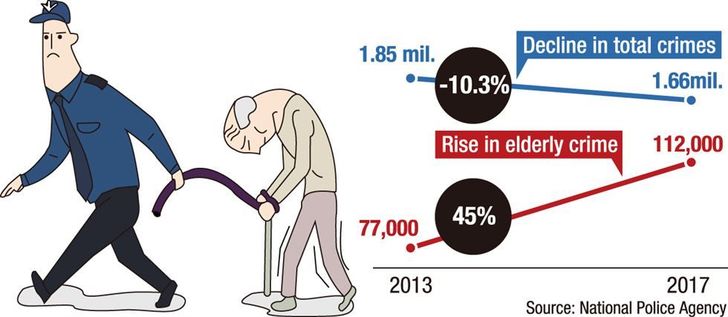
The rise in elderly crimes is significant as the total number of felonies committed by other age groups has been on the decline.
According to statistics from the National Police Agency (NPA), the number of crimes committed by people over the age of 65 has risen 45 percent in the last five years: In 2013, senior citizens committed over 77,000 crimes but that number shot up to around 112,000 in 2017.
There were 1.85 million crimes committed by all age groups in 2013, but that number dropped to 1.66 million in 2017.
The number of elderly people committing felonies including murder and robbery increased 70.2 percent from 1,062 in 2013 to 1,808 last year, while that of people charged with assault and causing injury also jumped 43.1 percent from 14,216 to 20,350 during the same period.
Experts call for specific countermeasures to prevent crimes by the elderly.
“To prevent, contain and drastically reduce elderly crime, the government needs to figure out why the crimes are happening in the first place and carry out specific countermeasures for the group,” said Lee Hyung-kuk, an adviser for the Korea Criminal Law Association.
A 2017 survey by the Ministry of Health and Welfare stated that more and more elderly people are having a difficult time adapting to society and getting isolated, saying their emotional state, including anxiety and discontent, is believed to be correlated to the increase in crimes.
According to the ministry's analysis, over one-fifth of senior citizens, or 21.1 percent, were suffering from depression, 6.7 percent have felt suicidal, and 13.2 percent have tried to commit suicide.
Furthermore, more and more senior citizens are living alone. Of the total people aged over 65, 19.7 percent were living alone in 2008, but this jumped to 23.6 percent last year.
Among those living alone, 80 percent of those over the age of 85 faced trouble such as having no one to nurse them when sick (19 percent), financial difficulty (17.3 percent), and loneliness (10.3 percent).
“We need specific support measures for the low-income elderly who are suffering from anxiety and depression,” the ministry said in a report.