Korean gov't ignoring $45 million pig-to-human transplant project?
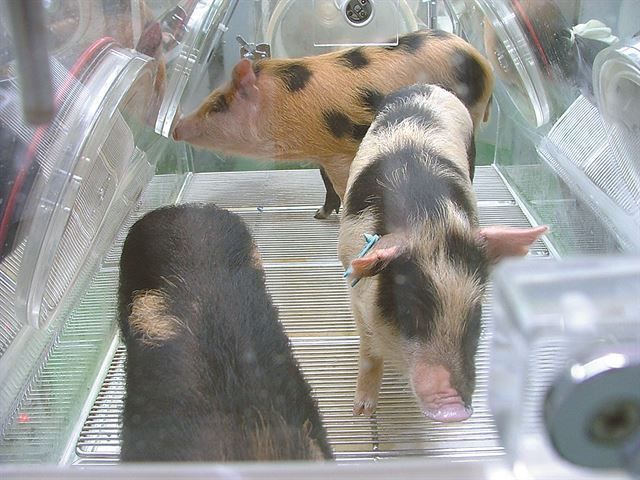
"Mini pigs" in a germ-free cage at Seoul National University College of Medicine. Korea Times file
By Ko Dong-hwan
A South Korean medical scientist says his team's possible breakthrough in treating human diabetes by transplanting pig organs to patients may be forced to end because the government has stopped financial support.
Park Jung-gyu, who leads a study into the xenogenic transplants of pigs' pancreatic?islets to type-1 diabetes patients at Seoul National University, told reporters on Aug. 23 the project may not be complete before its due period ends. The study, in which the government has invested about 50 billion won ($44.6 million) over the past 14 years, was supposed to include a clinical study from November this year to May 2019. But Park said this was in doubt because of a lack of funding.
“It has become more likely that, even after we have developed an innovative way to transplant pig's pancreatic islets to treat human diabetes, we may not be able to complete the clinical study without the government funds,” Park told a press conference at an eatery in Seoul's Gwanghwamun district.
Park's team transplanted a pig organ to a monkey with diabetes in November 2015, and the result was positive, with the monkey maintaining a normal blood sugar count for about 1,000 days.
The project started 14 years ago when the disease, which is usually diagnosed in juveniles, could be treated only by injecting insulin. But this treatment can cause other complications. The disease can be treated with a pancreas transplant, but the number of suitable donors is limited.
Park told reporters that the most important issues were “laws and authorities that protect the patients,” but Korean laws had yet to rule on xenogenic transplants. He said none of the related government branches ― including the Ministry of Health and Welfare, the Korea Centers for Disease Control and Prevention, and Ministry of Food and Drug Safety ― claimed their authority over the ongoing study.
If the clinical study due to next May remained unfunded, the project would end as a waste of money, Park warned. He said this would also mean “losing global leadership in xenogenic transplants.”
Park will hold a public hearing at the university's medical school on Aug. 29 inviting experts, the health ministry officials and patients.