Social perception toward obesity needs change
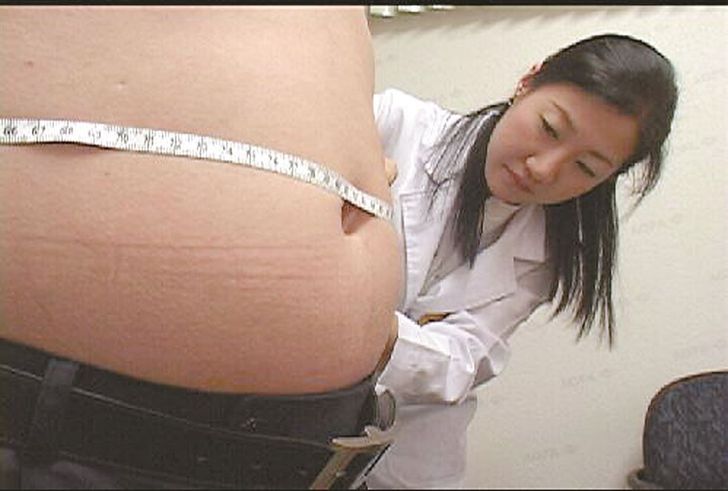
A doctor measures a patient's waistline to treat his illness stemming from obesity in this 2005 file photo. / Korea Times
By Jung Da-min
The annual social and economic costs to cure illnesses stemming from obesity have doubled over the last decade, according to the National Health Insurance Corp. (NHIC), the state-run insurance company.
Its latest report showed the costs reached nearly 10 trillion won in 2015, up from about 5 trillion won in 2006.
The costs include direct medical expenses to cover illnesses stemming from obesity, the loss of future income due to premature death, the loss of productivity following medical treatment, the costs of nursing and transportation.
The population of people getting fatter is growing rapidly, just as the aging population is.
More than a third of Korean adults are obese, according to the Ministry of Health and Welfare.
Graphic illustration by Kim In-ha (jimmyk1476@gmail.com)
In 1998, one in four was overweight.
“Obesity is no longer the problem of a small minority,” said Kim Yong-hwan, a doctor at Yonsei Severance Hospital in Seoul.
Asians with a body mass index (BMI) of over 25 are classified as obese, according to the World Health Organization (WHO).
Those with a BMI of more than 30 are “extremely obese,” it added.
“The problem revolves around those who really need medical treatment who do not come for consultation, while more of those with BMIs below 25 tend to come for cosmetic reasons,” Kim said.
This is because Koreans do not see obesity as a problem that needs medical treatment. They tend to treat obesity through cosmetic surgery, which is not right, the doctor noted.
Over 20 years have passed since the WHO tried to inform the world's population that “obesity is a disease.”
But the social perception of obesity in Korea still seems to be the same _ a matter of looks, not health.
Koreans often associate being fat with being lazy. And being fat is a personal problem, not a social one.
“When I search keywords such as 'a fat person,' or 'a fat woman,' I see much content that refers to these words with disgust or hatred,” said a 29-year-old woman who used to weigh 99.7kg, before losing 42kg. With her height of 168cm, she once belonged to the category of “extremely obese,” with a BMI of about 35.3.
Working as a school teacher after losing weight, she was often complimented that she seemed to get along and lead her students well because she is pretty and nice.
“I feel bad hearing those compliments because I do not believe my job performance would be affected by my weight.”
There is another prejudice _ an obese person is lazy.
“I went on a diet before the job interview fearing the interviewers would think I am too slow to work.” she said.
“But the most diligent days of my life were when I was obese, studying 15 hours every day at the college library.”
The misperception of obesity is deeply rooted in society.
“Even I feel the same hatred or disgust toward the obese, seeing them as failures or losers,” she said.
“Maybe I am harsher on those who fail to lose weight by working out because I am a winner in this game.”
However, Dr. Kim said it could be dangerous to lose weight by working out for those who are extremely overweight.
“This is why the government plans to support health insurance coverage for some medical costs to treat obesity at the end of this year.”
The government is planning to begin a health insurance system for obesity to cover the costs of medical treatments such as stomach bands, bypass or gastric resection, beginning in November of this year, the health ministry said.
But more efforts are needed to change the social perception of obesity.
“The government needs to start a nationwide project similar to the U.S.'s 'Let's Move' campaign.”
In the United States, the “Let's Move” campaign was started in 2010, led by then first lady Michelle Obama.
The U.S. established the Task Force on Childhood Obesity, with the goal to resolve the problem of childhood obesity within a generation.
The campaign included updating school meal nutrition standards and nutrition labels for packaged foods.
The adult obesity rate in the U.S. stood at 36.5 percent as of 2014, according to the Centers for Disease Control and Prevention.
“In Korea, there is no systematic record for national-level programs or campaigns such as the ones in the U.S.,” Kim said.
“Most of the national preventive programs in Korea are being operated by the NHIC. But all they have are fancy slogans without providing any records of what they have done.”