Kwangdong Pharm boasts success via business portfolio diversification
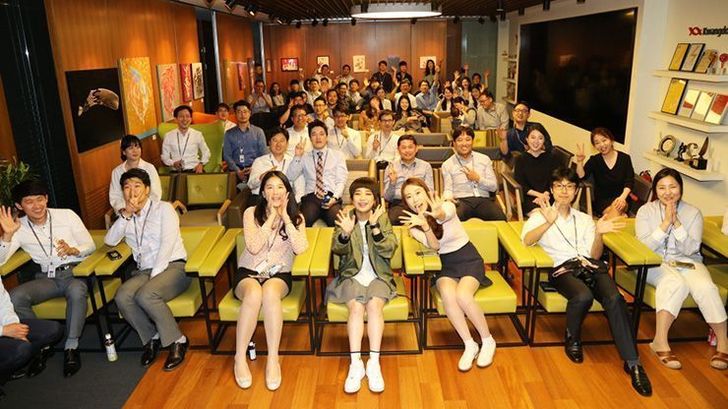
Kwangdong employees pose for a photo after watching a musical performance held at the company office in Seocho-gu, southern Seoul. / Courtesy of Kwangdong
By Lee Kyung-min
Kwangdong Pharmaceutical Vice Chairman Choi Sung-won
Kwangdong Pharmaceutical has successfully diversified its business portfolio, leading the industry in which many struggle to find a sustainable growth engine amid growing pressure to develop high-quality products, the company said Wednesday.
Led by Vice Chairman Choi Sung-won, the firm is confident about achieving its vision of “2020 Triple 1,” which stands for 1 trillion won ($879 million) in company value, 1 trillion won in sales and a 10 percent operating profit by 2020, when measured by separate financial statements.
“Not many companies have managed to successfully pursue both the drug business and other businesses too,” said Choi.
“Kwangdong has established a virtuous cycle of new business-derived profit being put into continued investment for high-quality products while minimizing the market fluctuation risk,” he added.
Established in 1963, Kwangdong has firm customer confidence in the traditional Oriental medicine market with its signature product being Kyung Ok Go, for which it obtained a patent from the Japan Patent Office in March for its ingredient that helps treat male infertility.
Other popular products include the herbal tonic drink Kwangdong Ssangwha Tang, Woo Whang Chong Shim Won, which helps treat strokes and neurotic palpitations, and Gongjindan, which helps treat fatigue in patients who underwent surgery or those who suffer from chronic exhaustion in general, according to the company.
Its hit drinks include Vita 500 and Corn Silk Tea, both of which were launched in the 2000s and continue to be the firm’s stable sources of revenue.
Kwangdong employees look at paintings at the Gasan Millennium Garden in the company building in Seocho-gu, southern Seoul. / Courtesy of Kwangdong
The firm’s major cash cow, Vita 500, a vitamin C drink, was developed to help people increase their daily vitamin intake by offering it as a beverage rather than pills, which are harder to swallow. It posted sales of more than 20 million bottles in four months in 2001 when it was introduced.
Buoyed by its success, Kwangdong expanded business to manufacturing beverages including Corn Silk Tea and hovenia dulcis leaf extract tea.
By separate financial statements, the firm posted 636 billion won in sales last year, up 11 percent from the previous year.
More than 40 percent, or 435 billion won, came from beverage sales, which increased 7 percent from a year earlier. Drug sales posted about 200 billion won, up 22 percent from a year earlier on the back of steady sales of 67 new drugs launched over the past four years.
SamDaSoo, the country’s most popular bottled water brand, distributed by Kwangdong, posted 183.7 billion won in sales last year, up 9.7 percent from the previous year. First quarter sales this year increased 10 percent compared to the same period from the previous year.
The bottled water originating from Jeju Island has become another cash cow since 2012 when the firm signed a contract with the Jeju Province Development Co. to have the exclusive right to distribute it.
By consolidated financial statements, the firm posted 1.56 trillion won in sales last year, coming in third in the industry after Yuhan Corp. and Green Cross Corp. The jump is attributed to acquiring Korea e Platform Co., an IT-based maintenance, repair and operation (MRO) logistics services firm in 2015. The MRO firm posted 423 billion won in sales last year.
In 2015, the firm adopted an enterprise resource planning system to better enhance management efficiency amid global market fluctuations.
The new information management system, designed to foster interconnection among manufacturing, purchasing, marketing, distribution, management, accounting and human resources departments, enables real-time, automatic management of stock, thereby ultimately bringing the company maximum profits, the firm said.
“According to data from Statistics Korea, the number of companies in business in 2015 was 5.55 million, down 5,000 compared to the previous year. The number of companies that ceased operation stood at 777,000, up 112,000 compared to the previous year. Amid this tough economic climate, Kwangdong will continue to strive to be an exemplary leader,” Choi said.