Nationwide transportation ban imposed to fight raging bird flu
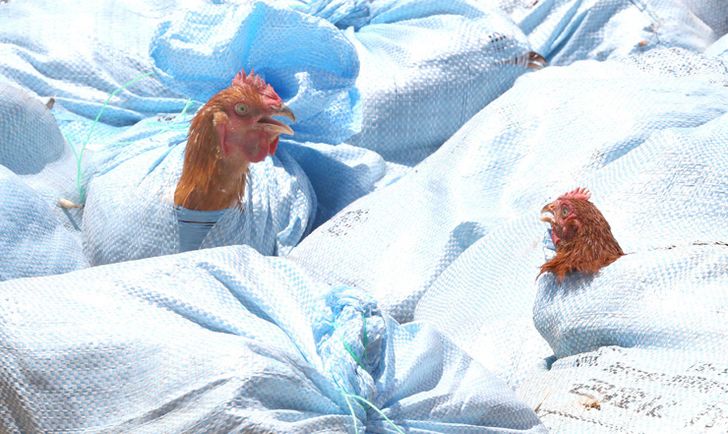
Flu-suspected chickens are covered with sacks before culling at a farm in Busan, South Gyeongsang Province, Monday. / Yonhap
Gov’t raises alert level to maximum
By Jung Min-ho
The government ordered a nationwide transportation ban and preemptive disinfection for all poultry farms and their equipment Monday, in an urgent effort to prevent another outbreak of avian influenza.
It has also raised the bird flu alert level to the maximum, after confirming recent infections involved a “highly pathogenic” H5N8 strain.
The move came just a few months after a previous bird flu outbreak, which resulted in the government culling of 38 million chickens and ducks from last November to April.
The Ministry of Agriculture, Food and Rural Affairs said it has ordered all places linked to the poultry industry across Korea, including farms and slaughterhouses to halt all deliveries of products and movement of equipment on Wednesday.
The ministry will carry out cleaning and disinfections during the day, in cooperation with the Korea Centers for Disease Control and Prevention (KCDC) and regional governments.
Since the first suspected case was reported on Jeju Island, June 2, the virus has been confirmed in cities across the country, raising fear among poultry farmers.
Prime Minister Lee Nak-yon issued the order after an emergency meeting, in which he and Agriculture Minister Kim Jae-soo vowed to take prompt, decisive action before the situation gets out of control.
The ministry believes a poultry farm in Gunsan, North Jeolla Province, is the source of the epidemic. So far, the virus has been confirmed in four other cities, including Busan in South Gyeongsang Province, Paju in Gyeonggi Province and Jeju Island.
More than 30,000 chickens and ducks have already been culled as a precaution. Many fear that this may only be the beginning.
The ministry is investigating the cause of the outbreak and the 3,600 flu-suspected chickens the Gunsan farm sold to six cities across the country.
“We believe the epidemic began from a virus that stayed alive despite the government’s disinfection efforts during the previous flu epidemic,” a ministry official told reporters Monday. “We don’t think a new virus from overseas is the cause.”
The ministry is also investigating the poultry farmers, who allegedly hid flu-suspected cases for fear of financial losses.
Avian flu outbreaks usually occur in Korea during the winter or spring, when migratory birds fly in from China. It is rarely found here in the summer, given that the virus is vulnerable to high temperatures and humidity.
Although the H5N8 strain does not spread as fast as the H5N6 strain, it has a long incubation period, which makes it difficult to eradicate.
This is why experts now worry that a repeated epidemic may happen here regardless of the season, which could also raise the risk of human infections.
Although H5N8 is considered one of the less pathogenic subtypes for humans, it is beginning to become more pathogenic.
The Korea Centers for Disease Control and Prevention said the likelihood of human infection is low, but it cannot be excluded, given the cases found in China.
It was the H5N6 virus that plunged the poultry industry into a huge crisis only several months ago. According to the Hyundai Research Institute, the country lost about 1 trillion won ($900 million) because of the epidemic.
The fresh crisis is also expected to cause major damage to the country, if the government fails to curb it in the initial stages.
Consumers are concerned that the crisis may again lead to price hikes for eggs and chicken.