Expats want friendlier Seoul
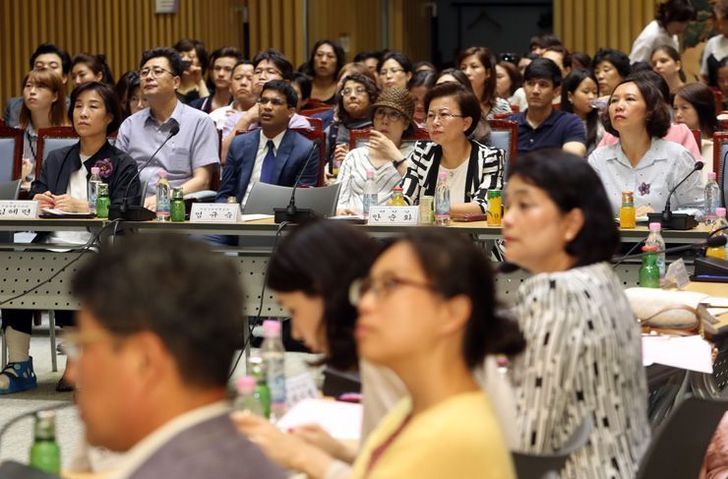
Foreign residents gather at City Hall, Wednesday, to propose policies to improve living conditions for the growing foreign population in Seoul. / Yonhap
By You Soo-sun
Foreign residents of Seoul gathered at City Hall, Wednesday, to propose policies to the Seoul Metropolitan Government on behalf of foreign residents of Seoul. It was the third time the Seoul City Foreign Residents Council, consisting of 38 residents from 23 countries, held a general meeting since its launch in December 2015.
Eleven policies were proposed, of which five were presented at the meeting. The proposals arose from the 11 meetings held this year separately by each division: human rights and cultural diversity, capacity building and improvement of living conditions.
Taraki Mari, 27, from Switzerland proposed establishing prayer rooms for Muslims, who are obligated to pray five times a day at certain times of the day. She has been a resident here for seven years, and has found it difficult to practice her religion here.
“There were times when I prayed at corners of the subway station or on the emergency staircase of a building,” she said according to a local newspaper. “To reflect the growing Muslim population residing in Korea, I hope we can be respected as part of the community.”
She also said, “Establishment of prayer rooms will also give a good impression for Muslim tourists in Korea.”
Proposals for improving living conditions included providing different foreign languages on maps and road signs as well as services at the multicultural family support center to foster cultural exchange and help foreign residents better adjust here.
“I once got off at Itaewon Station to go to the Uzbekistan embassy, but I couldn’t find any map or directions indicating its location. Even a few I found were only in Korean and English, blocking access to non-English-speaking foreigners,” a participant said.
Other policies included easier access to earning drivers’ licenses, using Noksapyeong Station on Line 6 as an exhibition hall showcasing different communities from around the world and subsidizing free subway access for long-term senior foreign residents.
The council was established as an advisory body under the city government’s Women and Family Policy Affairs division as a means to improve the quality of life for foreign residents here. As of 2015, there were 457,806 foreigners living in Seoul, up from 395,640 in 2013.
Last year, 33 policies were proposed. The Seoul city government accepted 17 of those, including providing Korean language courses, educating migrant children in their native languages and including foreign languages in ads delivered to areas heavily populated by foreigners.
“The policy proposals from the Foreign Residents Council are great examples of providing solutions through communication and collaboration,” said an official from the Women and Family Policy Affairs Office. “We expect the council to play an important role in establishing effective policies for expats living here.”